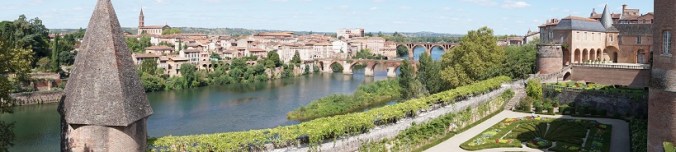
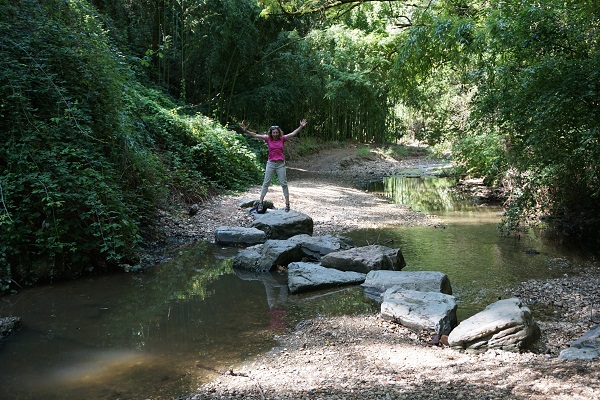
One of the best things about the campsite at Albi was the walk into Albi itself. A half hour walk, it followed the course of a small stream through meadows and bamboo plantations, arriving a couple of minutes walk from the main Cathedral square. We were here to see the Toulouse Lautrec museum, right next to the Cathedral.
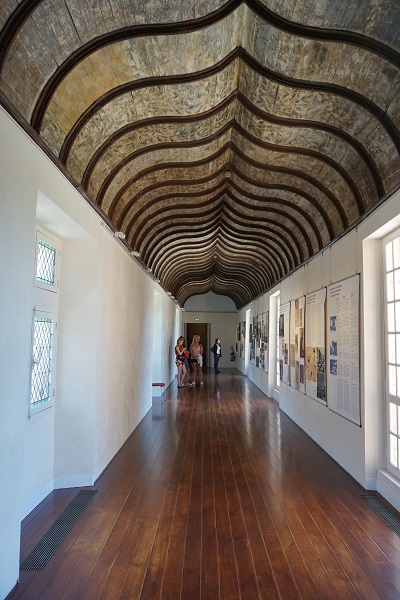
The museum is housed in a beautiful building, a Bishop’s Palace from the 14th century which has been painstakingly restored in recent years, revealing tiled floors and painted ceilings which had been hidden under layers of paint and concrete for years. The gardens outside are also very beautiful. They were designed by the wonderfully named Hyacinthe Serroni from 1687-1703 and make great use of vegetables in the flower beds.
Toulouse Lautrec was born in Albi into a wealthy family, the son of Count Toulouse Lautrec. The collection spans his life from his first youthful scribblings to his famous posters featuring the nightlife of Montmartre and beyond to his final works.
Everyone knows that T-L was a very small man but I wasn’t sure why. Apparently, he had a congentinal weakness. A childhood accident lead to him breaking both his legs, after which time he failed to grow. He lead a somewhat wild life, hanging around the dance halls and whore houses of Paris – his poor mother seemed to spend her time trying and failing to keep him out of trouble. He suffered from pain all his life and could only work in short bursts: many of his pictures took dozens of sittings to complete. In his thirties he was hospitalised for mental affliction and alcoholism. He died at the tender age of 37, suffering from Syphilis and Alcoholism.
The work itself is wonderful. He enjoys drawing horses, but his chief passion is people. He covers them all from countesses to circus performers. At times the images are cartoonish, at other times they are more fully realised, but everything is driven by his desire to understand his subject – to get behind the image they project to the world and to reveal the essence of their character. And at the same time, he somehow conveys something of his own personality – his wit, his irreverence, his playfulness.
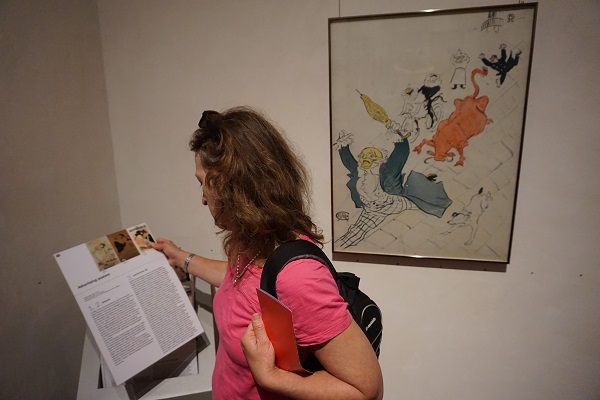
As time went on, he became more and more interested in capturing the fleeting moment, moving from realism to a more abstract use of form and line. A single line conveys the sweep of a dress as a woman dances, another a tall man in a top hat, or a row of cellos. This style is refined and simplified for the brilliant poster art which made his name.
In all his work, there is great joie de vivre, but a strong sense of foreboding , too. Some of his portraits are very dark, particularly his many portraits of doctors. Given the state of his health, I’m not surprised. He was always on borrowed time.
 Senior gap year
I love the walk and the roof of the ‘gallery’ and the excellent, perceptive information about Toulouse Lautrec.
LikeLike