A secret beach to the north of L’Ouille, Collioures, France


Coll wave small

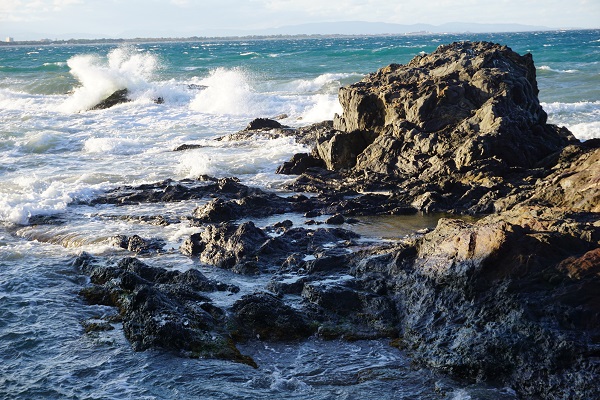
Last day at Les Amandiers, and it was a beauty, the sun shining all day long. We decided to stay local, moving between beach and camp site. David proposed that we revisit one of his childhood pleasures and to take a long swim round to a secret beach to the North of L’Ouille. I agreed readily –  he had me at “long swim”, never mind “secret beach”.  A part of me was struggling to get used to the idea of David volunteering to swim in cold water but I kept quiet about that. So we kitted ourselves out in wet shoes, snorkels and masks and slapped on the factor 30. However, having waded knee deep, a gust of cold wind hit us and David looked at me in alarm – “That water is c-c-cold! Do we really want to do this?” For a moment I was tempted to chuck in the towel. Or rather go and snuggle up in a towel on the beach. But no! We had come too far – there was no backing out now. “We’re doing this!”

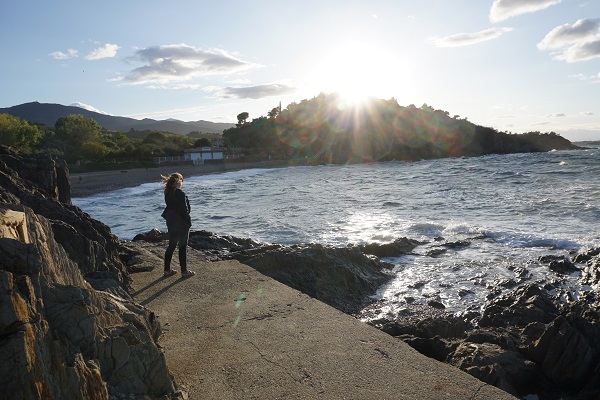
A few squeals and winces later we were in. Not so bad when you’re in. The pebbles shot with streaks of silver (mica) which sparkled in the sunlight. Clusters of rocks appeared to our left, studded with sea urchins. Plenty of fish. Some of them quite large. Now we were coming round the headland, passing a jagged rock festooned with cormorants and/or shags drying their wings, unperturbed by our presence.  We were approaching the secret beach – but clearly the secret was out.  A couple with a kayak were already there. Boo! Fortunately they were just leaving. We waited for them to go and then waded ashore. David pronounced it much smaller than he remembered. Out of the water, I shivered as a gust of wind chilled my skin. Fortunately there were some large sun warmed slabs of rock to lean against.  We briefly debated swimming round to the next bay but decided against it. Probably wise as the swim back was into the wind, which slowed us down.  Arriving back on the beach, there was a small but definite sense of achievement.

In the evening, we went to the modest on site café for a Paella evening which had been advertised in the camp shop. They cook the Paella in a huge dish and share it out between everyone. I don’t usually eat Paella as I don’t eat meat and it tends to be cooked in chicken stock, even if you avoid the lumps of chicken. However, we’d decided it would be a good thing to do and give us a chance to practice our French.  Sure enough, we were the only non-French people attending. As the Sangria was passed round, David abruptly started to introduce himself to the couple at the next table. They looked slightly surprised –  then responded warmly. We spent the rest of the evening chatting away to this retired couple from somewhere near the Swiss border and another, younger couple with a baby who were on our other side. Sadly I can’t remember any names but we did find out quite a bit about them. As the evening wore on, I found the French coming more easily, as they Sangria and wine flowed. The retired man sitting next to David shared a carafe of Rose with him and held forth at length about the state of Europe and Brexit – I couldn’t follow more than half but he was definitely pro-Brexit. We left at the end of the evening with another small but definite sense of achievement. We had ventured out of our comfort zone and spoken French all evening. But God, it’s exhausting! And I suspect much of my French is Franglais. More practice definitely needed.
Col nell beach small

Jazz Festival in Le commune Libre de Racou, France

nell beach pano small

I am not a big one for planning. And neither is David. Some may view it as a failure to think ahead. I prefer to think of it as ‘keeping spontaneity alive’! In life, but especially on a trip like this, it has its advantages and disadvantages. We often miss things, because we didn’t know they were on. On the other hand, we stumble across things, and how sweet it is to suddenly find yourself part of something totally unexpected. Like the Jazz Festival of Racou.

Les Amandiers. It had been lashing with rain all day and we were going slightly stir crazy in the campervan. Books had been read. Blogs had been written. Board games had even been played. Now it was almost 5 pm and the rain had slowed. David suggested we put on our raincoats and go for what my grandfather called a ‘constitutional’. A wander down to the beach at L’Ouille wasn’t enough, so we opted to take an unpromising path with no sign post, heading East of the campsite.  We soon found ourselves wandering round an uninhabited stretch of coastline, looking down from a cliff to a series of small coves. A longer stretch of beach with some sailing dinghies pulled up on the sand came into view and, since the rain had now stopped,  we decided to go and take a look – it might be nice to hire a boat on a better day. As we approached, a street decked in flags came into view. We saw some tarpaulins being pulled off to reveal a small outdoor stage and stopped to have a drink at a conveniently placed open air bar. Which is when we realised we had stumbled across the Jazz Festival of Racou.

And what a great time we had.

Racou, or ‘Le commune Libre de Racou’ as it proclaimed itself on the glasses at the bar, is a pretty little enclave of huts and cottages, the front line of which open right onto the beach. Behind the houses is a small street lined with restaurants and bars. And that was where the festival was.  There were three stages dotted along the street, and people were eating in the restaurants, or drinking in the temporary bars, or wandering along the street taking it all in.  A few minutes after we arrived, a motley crew of musicians suddenly started to play ‘Oh when the Saints’ and as they set off up the street, the crowd was showered with confetti. The Jazz Festival had begun! The carnival atmosphere continued as musicians came and went throughout the evening, joining in with the various acts on the stage, supplementing the main performers with improvised riffs and solos. That waiter who just served you in the bar suddenly appears on the stage, brandishing a trumpet. There was a woman from Cote D’Ivoire with a voice like Nina Simone. There was an all-female band making the audience laugh with their novelty songs, the ukulele player heavily pregnant. Fleeting impressions of an evening which felt somewhat unreal because it was so unexpected.

Sadly we had to leave before the end as we wanted to leave plenty of time to find our way back across the cliff tops in the dark – but back in the van I opened the curtain and caught a glimpse of the closing fireworks.

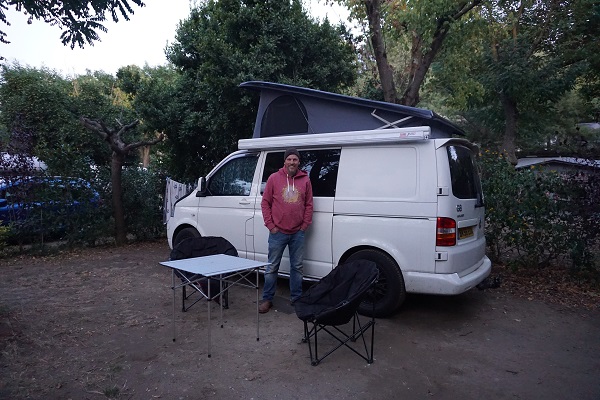
dave vansmall

Matisse, Derain, Bracque and Picasso in Coulieres, France

coll pano 2 small

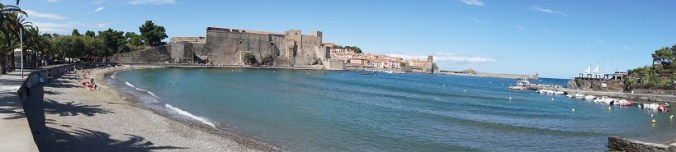
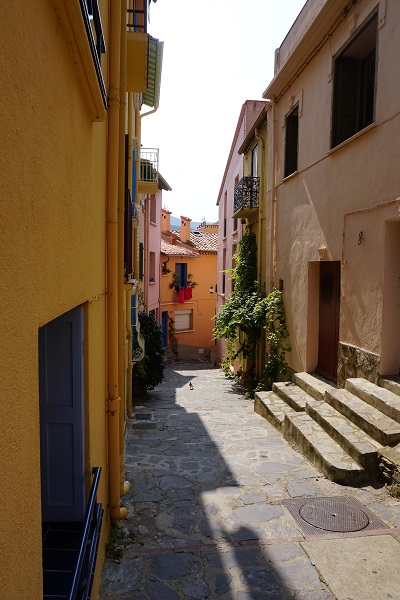
From Les Amandiers, it is a two minute walk down to the beach at L’Ouille and then a further twenty minutes walk over the cliffs to Collioures. The walk is wild and spectacular, clinging to the edge of the cliffs or winding inland past Fort Carre, an ancient defence against the Spanish. This part of the country has been fought over by the French and Spanish for hundreds of years. Collioures itself was originally a Catalan fishing town (“Coltiures” in Catalan) specialising in anchovies and sardines, and it is still possible to buy anchovies in the town. The fishing trade has long gone. The town has become a magnate for tourists, drawn by the beautiful curving bay lined with restaurants, the steep, winding streets full of gift shops. The houses are painted in various shades of ochre and terracotta, all set against a backdrop of the Pyrenees.

coll town small

The town has a strong artistic bent which dates back to the turn of the century and its association with artists like Matisse, Derain, Bracque and Picasso. I’ve been reading the first volume of  ‘The Unknown Matisse’ the brilliant biography of Matisse by Hilary Spurling which I’ve borrowed from my parents (thanks mum and dad!) and Collioure features heavily. Matisse was the first artist to ‘discover’ Collioure and paved the way for many more artists to come here.

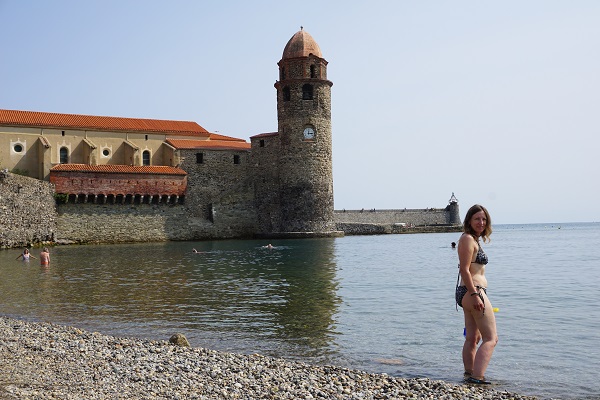
In 1905, Matisse was looking for somewhere cheap to paint for the summer, and having travelled by train from Paris to Perpignan, he continued West down the coast until he reached Collioure. Board and lodgings at the station hotel was secured for the bargain price of 150 francs a month for Matisse his wife Amelie and their children. That summer turned out to be momentous for Matisse, who was soon joined by another young artist, Derain.  They set up a studio above a café overlooking the bay.  Together they painted round the clock, producing dozens of canvases. They painted scenes of everyday life in the village: boats departing to fish in the morning, boats returning at night. They painted the fisherman, their wives and daughters, the sea and the distinctive tower of the church of Notre-Dame-des-Anges, a converted lighthouse which dominated the view from the studio.

coll boats small

Today, swimming at Collioure is a joy, with several different beaches to choose from. The fish are so tame you can get them to take bread from your hand. But in 1905 the water was a thick stew of fish guts and sewage, so each day Matisse and family walked round the cliff top path to swim in the clear waters of L’Ouille.  The same path cliff top path that we walked from L’Ouille to Collioures! There are several well known paintings of Amelie, his wife, posing on the rocks at L’Ouille.

The light at Collioure, which today inspires tourists to take endless photos of the town, inspired Matisse and Derain to tear up the rule book and allowed themselves to focus on light and colour. As Derain wrote in a letter to a friend,

“colours became sticks of dynamite. They exploded into light.”

The resulting works created a furore when they were exhibited in Paris.  The term ‘Fauves’ was coined to describe this shocking new art work by critic Louis Vauxelles – ‘wild beasts’. And yet, very soon, the work began to be recognised as extraordinary. Leo and Gertrude Stein purchased ‘Woman in a Hat’, an image of Amelie, and soon other collectors caught on. Painters such as Picasso and Braques were inspired to imitate or outdo. Matisse’s place in the history of art was assured.

Today, there are a number of Matisse and Derain’s works displayed round the town, positioned exactly where they were painted. There are also several empty picture frames which you can look through and see an image of the town ‘framed’ as a work of art. And of course, there are artists studios everywhere, as artists continue to be inspired by Matisse –  and by Collioure.

nell paddles small

Les Amandiers, L’Ouille beach, France

col & nell small

Arrived at ‘Les Amandiers’ campsite just behind L’Ouille beach, around the corner from Collioure. It is not the first time I have stayed in the area – we stayed in a campsite in Argeles-sur-mer ‘en famille’ about ten years ago (with friends Barry and Fiona Edwards). But it is my first time at ‘Les Amandiers’. On arriving the campsite manager said to David in French “I think you have been here before, yes?” “Yes, that’s right,” said David, “in 1976.” The man looked slightly surprised! I guess he was thinking of a more recent Scull visit: David’s parents came here a couple of years ago. David’s love for this part of France runs in the family.

For those of you who don’t know, David’s family spent some time living in France in the 1970’s. David’s father was an aeronautical engineer who worked for Rolls Royce. He was part of the brilliant team who worked on Concorde, first in Toulouse and then in Paris. David spent a year attending a French comprehensive in Toulouse before he transferred to boarding school in the UK. So his rusty French is considerably better than my ‘A’ level rusty French, and whilst I struggle to follow the accent down here, he finds it reassuringly familiar.

coll dave small

It was late afternoon by the time we headed down to L’Ouille, a small cove with an attractive pebbly beach somewhat reminiscent of the Southern coast of Cornwall. It was a windy day and the breakers were surprisingly large, but there were a handful of people swimming.  We went for a bit of an explore of the rocks and tried to follow the lower path to Collioure which David and his family used to take, but it has broken off and fallen into the sea. So we came back to the beach and gathering our courage, plunged into the sea. Bracing! I was quietly amazed to see David swimming, his usually refuses to venture into anything below 26 degrees, but this time he seemed to enjoy it. I’ll get him swimming in the English sea yet!

coll path small


Toulouse Lautrec museum, Albi, France

albi vista small

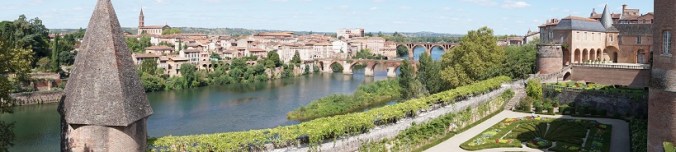
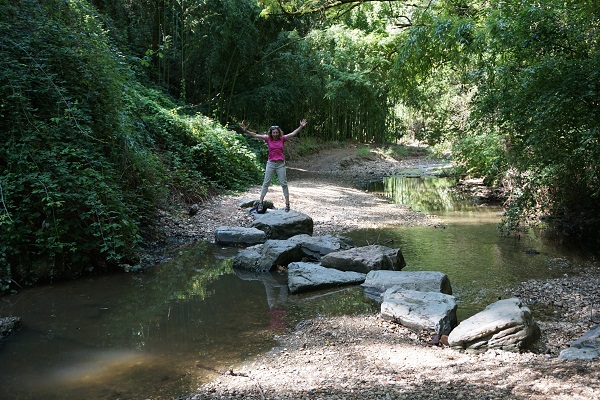
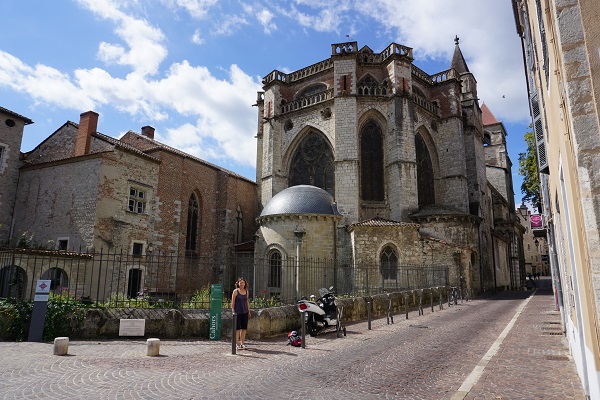
One of the best things about the campsite at Albi was the walk into Albi itself. A half hour walk, it followed the course of a small stream through meadows and bamboo plantations, arriving a couple of minutes walk from the main Cathedral square. We were here to see the Toulouse Lautrec museum, right next to the Cathedral.

nell wood small

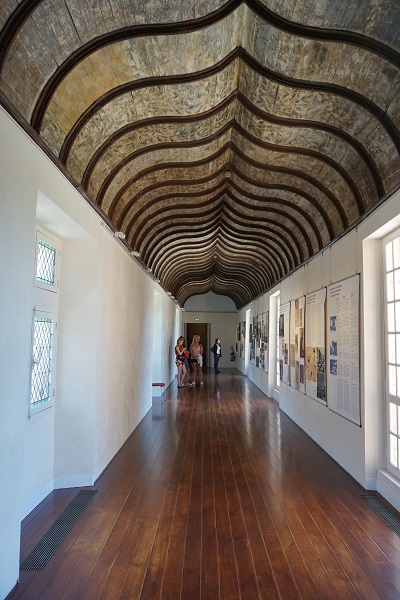
The museum is housed in a beautiful building, a Bishop’s Palace from the 14th century which has been painstakingly restored in recent years, revealing tiled floors and painted ceilings which had been hidden under layers of paint and concrete for years.    The gardens outside are also very beautiful. They were designed by the wonderfully named Hyacinthe Serroni from 1687-1703 and make great use of vegetables in the flower beds.

tl interior small

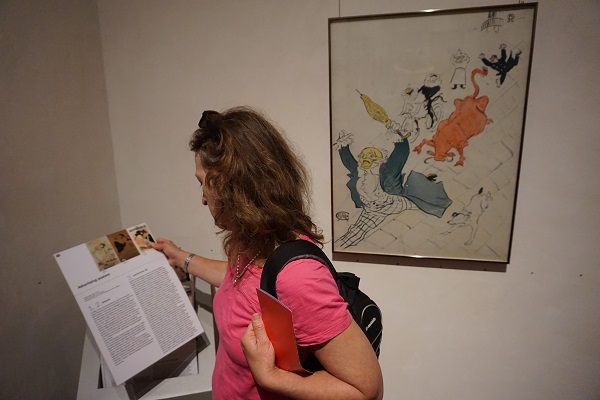
Toulouse Lautrec was born in Albi into a wealthy family, the son of Count Toulouse Lautrec. The collection spans his life from his first youthful scribblings to his famous posters featuring the nightlife of Montmartre and beyond to his final works.

Everyone knows that T-L was a very small man but I wasn’t sure why.  Apparently, he had a congentinal weakness.  A childhood accident lead to him breaking both his legs, after which time he failed to grow.  He lead a somewhat wild life, hanging around the dance halls and whore houses of Paris  – his poor mother seemed to spend her time trying and failing to keep him out of trouble. He suffered from pain all his life and could only work in short bursts: many of his pictures took dozens of sittings to complete. In his thirties he was hospitalised for mental affliction and alcoholism.  He died at the tender age of 37, suffering from Syphilis and Alcoholism.

The work itself is wonderful. He enjoys drawing horses, but his chief passion is people. He covers them all from countesses to circus performers. At times the images are cartoonish, at other times they are more fully realised, but everything is driven by his desire to understand his subject – to get behind the image they project to the world and to reveal the essence of their character. And at the same time, he somehow conveys something of his own personality – his wit, his irreverence, his playfulness.

nell tl small

As time went on, he became more and more interested in capturing the fleeting moment, moving from realism to a more abstract use of form and line. A single line conveys the sweep of a dress as a woman dances, another a tall man in a top hat, or a row of cellos. This style is refined and simplified for the brilliant poster art which made his name.

In all his work, there is great joie de vivre, but a strong sense of foreboding , too.  Some of his portraits are very dark, particularly his many portraits of doctors. Given the state of his health, I’m not surprised. He was always on borrowed time.

Albi, France – NON!


D&N Albi small

French campsites are very different to English campsites, we are discovering.

Arriving at the campsite in Albi after a long day on the road, I was impressed by the vaulted reception hall which appeared to be modelled on an upmarket ski resort in the Rockies, complete with humorous American signs – ‘Beware of the bears!’, ‘Beavers crossing!’, that kind of thing. There was a restaurant taking bookings for the evening which offered lobsters to order. Reading the brochure at the desk while we waited to be signed in, I was further impressed to learn that there was a swimming pool, spa and Turkish hammam.  Could this be our best campsite so far?

We were shown to our pitch by a uniformed member of staff in a golf buggy. The site was wooded with tents, lodges and wooden tree houses dotted amongst the trees. I started to put up our tent which we use to throw stuff in to keep the van clear – barbecues, bags and so on. The weather was hot and it was a bit of a struggle, especially as there were mosquitos taking an interest in my legs, but I was keen to get it done so we could get on with enjoying our evening. I was just nailing in the last peg when I heard a voice behind me say “No. NO tent.”

“No tent? Oh no, sorry, we’re not sleeping in it, we just want somewhere to put our stuff..”

“Tents are not permitted. NO.”

So down came the tent while the guard, sorry member of staff, kept a close eye to make sure I complied. We would now have to live with all the clutter in the van. Why? No explanation was given. Rules are rules. They must be obeyed.

Not long after that, we went to play a game of table tennis. When we came back, we found that our door mat, the one which stops dirt coming in to the van, had been lifted off the floor and put on the table. It seemed as well as “NO Tent” there was a “NO door mat” policy.  I was beginning to dislike this place.

That was just the beginning. We soon discovered that there was a long list of “No’s.

  • NO walking on the grass.
  • NO tents on the grass.
  • NO doormats on the grass.

Infact, NO thing on the grass except campervans and motorhomes.

There were also:

  • NO barbecues, except in the allotted barbecue area.
  • NO noise after 10 pm – after 10 pm, SILENCE must be maintained (and believe me, it was. Walking back to the campervan at night, my flipflops were making such a racket, I was afraid they might set off an alarm!)

Oh, and in the pool:

  • NO Bermuda shorts and NO swim shorts. Only speedos. In a campsite which catered for largely for the over sixties, this seemed somewhat cruel. How many pensioners can carry off speedos?

And yet despite all these rules, campers were provided with:

  • NO soap to wash hands in the toilets.
  • NO towel or hand dryer.
  • And most heinous of all… NO toilet seats!!

In fact, these last three apply to pretty much every campsite we’ve been to in France. At least the Albi one had loo paper. Believe me, loo paper is a luxury.

And yet…there are many great facilities which you’ll find on a French campsite which you wouldn’t get on an English campsite.

  • A table tennis
  • Delicious fresh baguette/croissant/pain chocolat which you can order at reception for the next day’s breakfast.
  • A place to play Petanque.

I have to say, given the choice between a toilet seat and a place to play Petanque, I’d opt for the toilet seat, but that’s just me.

nell van clutter small

Valentre Bridge, Cahors, Lot, France

cahors small

David said he’d always wanted to go to Cahors, so Cahors it was. It was lunchtime when we arrived and the weather was hot, hot, hot. The streets by the car park were teeming with students from the nearby Lycee, lounging around on street corners smoking Gitanes or revving their mopeds and trying to look cool .  Clearly the new school term had started.

Cahors is the capital of the Lot department, surrounded on three sides by the River Lot. We walked along the course of the River, which was teaming with fish, until we came to the Medieval Quarter and then threaded our way through the cool, narrow streets. Unlike some towns we have visited in France, Cahors felt very much a living city. Builders were restoring several of the houses and the cafes were buzzing with locals. We passed a row of quirky shops selling artisan food, handmade clothes, and jazz records.

cahors 2 small

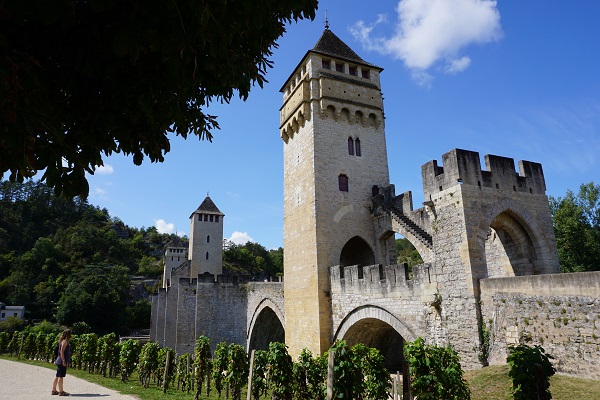
The river was spanned by a number of bridges but we were most keen to see the Valentre Bridge, which is the main tourist attraction of the town and is on the UNESCO World Heritage list _ unlike Sarlat-la-Caneda, which I blogged about recently – they’d like to be on the list but haven’t yet made it.) The bridge dates back to the 14th century, and took over 70 years to complete. I read that it was built to withstand British invasion. Well, these two Brits thought it very impressive, and it had the added bonus of being traffic free.

nell cahors small

Canoeing down the Dordogne, France


nell canoe 2 small

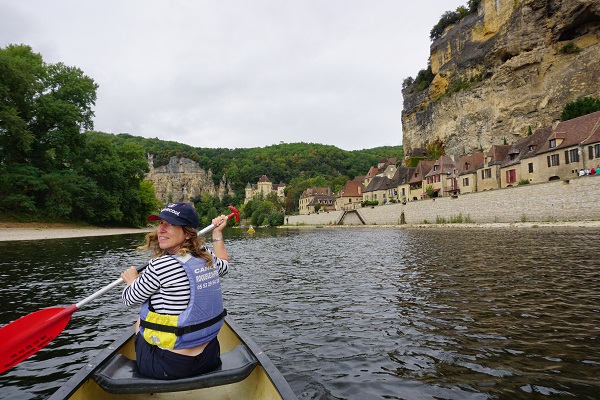
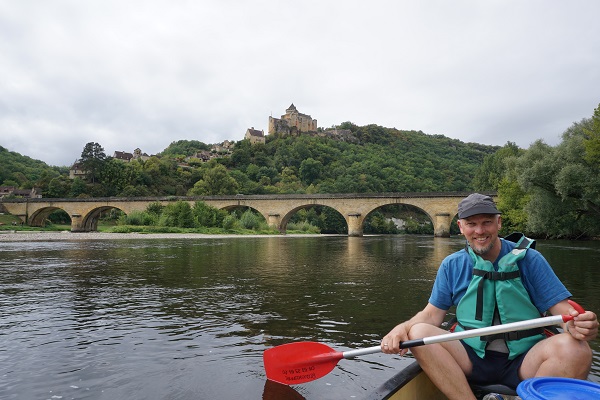
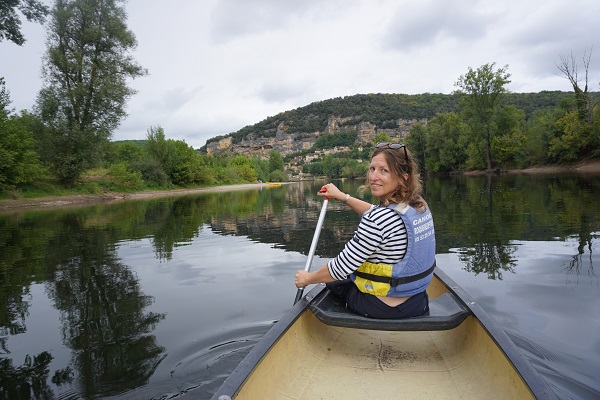
We’d done a lot of driving and a lot of sitting about and it felt like time to get off our behinds and do something physical. Canoeing down the Dordogne sounded fun, so we booked a trip with Canoe Vacances (www.canoevacances.com) at 20 euros each and drove down to La Roque Gageac to the river. This was to be our final destination for a 14 km trip, and so we and a handful of other grockles*  climbed into a minibus and were driven to Carsac.

We were given a two seater canoe, with me at the front and David at the back, each of us with a paddle. Fortunately I’m left handed and he’s right so we could both stick to our good side. It was lovely to get on the river, and despite my misgivings, the distance wasn’t a problem, as we were going downstream: even if we hadn’t paddled at all we still would have got there.  There was no danger of capsizing, which was good as I had forgotten to bring a costume. We were given a waterproof container to put everything in, but we didn’t really need much apart from sunglasses, suntan lotion and plenty of drinking water.

dave canoe small

We were first off in the group and eager to put a bit of distance from a rotund french girl in our party who seemed to enjoy screaming. I’m aware I’m sounding old but we wanted to enjoy the peace and quiet and were hopeful that we might see some wild life. As it turned out, we saw remarkably little, except for a heron and lots of dragonflies. This might have been because it wasn’t a particularly quiet stretch of river: there were quite a few ‘Norberts’ around (‘Norbert’ was the favoured name for the tourist boats – Norbert 1, Norbert 2 and so on) and a good many groups of kayaks and canoes.

The banks of the river were particularly scenic with picturesque ancient villages and bridges and what seemed to be a chateau around every corner. I’m not even going to try to record all their names here. By the end of the trip I’d been happy if I never saw a chateau again. It’s something to watch out for if you come to this region of France. Don’t make yourself sick by consuming too much chateaux!

*A grockle is a West Country word for a pasty skinned person dressed in shorts and a kagool, otherwise known as a tourist.

nell canoe small

Sarlat-la-Caneda and the Lanternes des Morts, France

sarlat 1 small

Sarlac-le-Caneda is a stunning town. Our campsite was on the outskirts, a ten minute walk to the perfectly preserved 14th century centre. It was a joy to wander round the maze of streets and winding passageways without being squashed – the streets are largely car free. In July and August, I imagine the number of tourists would be a challenge. Looking up at the turrets, the winding staircases, the arched windows and the balconies, I felt as if I was in a film set, so I was not surprised to read that it has featured in many films.  Apparently it was ‘saved’ by the dynamic Andre Malraux  (Minister of Culture, 1960-69) which earned him the honour of having a square named after him.  It developed around a large Benedictine Abbey, which later became the Cathedral.

sarlat 3 small

Above the Cathedral is a ‘Lanternes des Morts’, one of the many ‘lanterns of the dead’ which are dotted across the centre and west of France. These Moorish looking small, stone conical buildings with rooflights would be lit up at night to mark the position of a cemetery.

sarlat 2 small

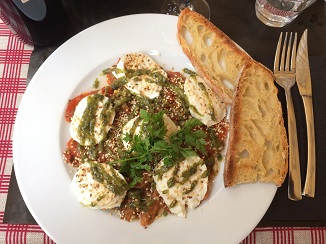
Around the central Place de la Liberte are a number of tempting restaurants, and we decided to sample one. It was a pleasure to sit outside and enjoy the beautiful location but the food wasn’t much cop – overpriced tourist fodder.

bad plate small

The whole town is obsessed with Foie Gras – there’s a large square dedicated to a goose market – but as a non meat eater, I was not even slightly tempted to give it a try.

nell sarlat small

Route de Noix to Sarlat-la-Caneda, France


The weather remained cool so we decided to cut our losses and head down to our next stopover a day early. Destination: the medieval town of Sarlat-la-Caneda.

At lunchtime, we came off the Satnav and wandered at will through the narrow lanes of the Hautes Viennes, into the land that time forgot. Abandoned houses standing empty, with birds flying in and out the windows. We came across the  tiny settlement of Pageas Chenevieres: just a farm and a few outbuildings, the thirteenth century church of Saint-Jean-Baptiste de Chenevieres and its large graveyard. Clearly this was once a thriving village. Some teenagers idly drove their car out of the farmyard and down through the fields as we set up our ‘picnique’ of bread and cheese.

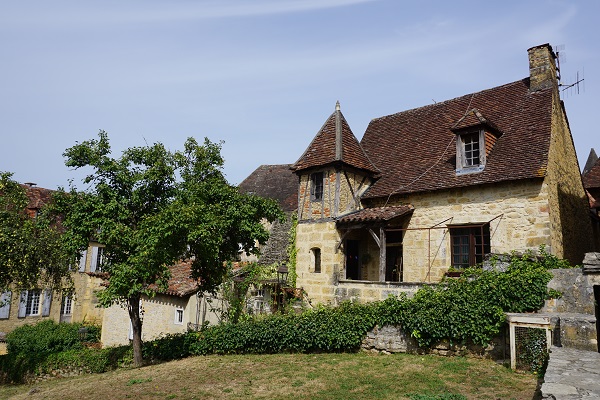
After lunch, we came down from the Viennes and into the Dordogne. The drive through the Perigord region was beautiful with ancient hamlets, the houses made from a warm yellow stone, reminiscent of the Cotswolds. First we were surrounded by orchards of apples and then apple trees gave way to walnut trees – signs informed us we were on the ‘Route de Noix’.  All rather lovely.  Note to self: buy walnuts.

However, later that afternoon, David forgot the ‘look to the left’ rule and almost wiped us out at a junction. A scary moment. So now the ‘driving cock up’ score is one all –  and let’s hope we can leave it at that!


dave small

Ooops