Anses d’Arlet, Martinique

ans 4

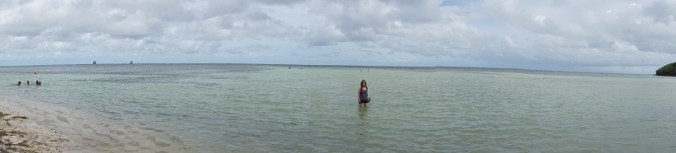
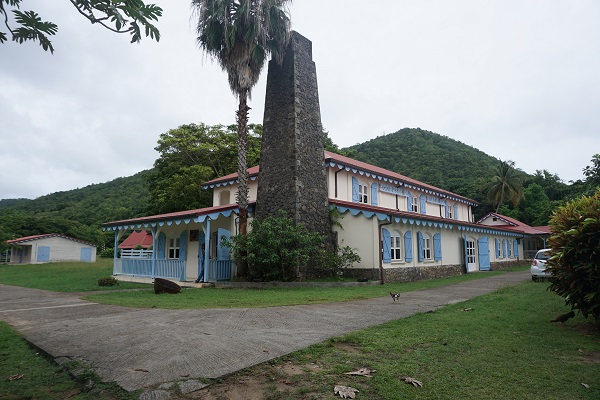
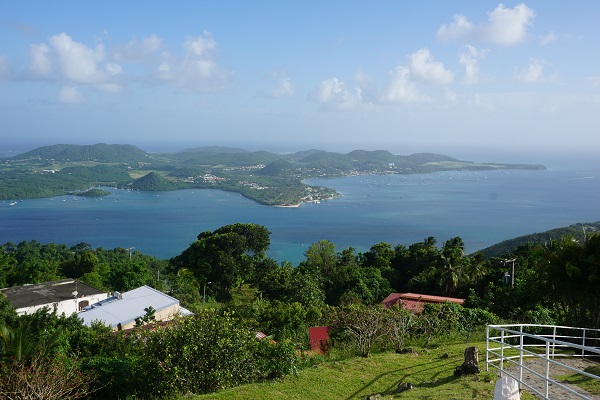
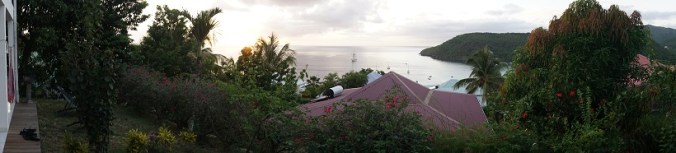
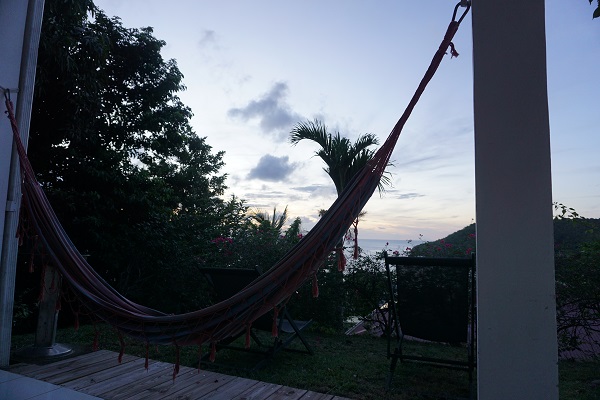
Today we said goodbye to Airstream Paradise and set off for our new home, a studio flat in Villa Felicites at Anses d’Arlet. David picked out Airstream Paradise. This one was my choice. I picked it because despite being a modest ground floor studio it had its own terrace and garden with views right over the bay – and a hammock! Back in the UK I had pictured myself lying there, swaying gently, watching the sunset, rum cocktail in hand.  Now we were here, would the reality live up to the dream?

On the drive over, we received a message in broken English from Carol, the housekeeper, to advise us that the road up to the house was being resurfaced and there was a diversion in place. Carol suggested we meet her so she could show us the way.  The message said that we would know her because “I will be wearing an orange serviette around my shoulder”. Orange serviette? I was intrigued – could this be some sort of traditional costume? We then spent a hair raising half of an hour trying –  and failing – to find Carol. It was very hot, the road up to the house was improbably steep, and the diversion promptly took us off road, with no clue how to get back again.

We finally found her. Traditional costume? Nope. he “orange serviette” was nothing more exciting than a small hand towel which she had thrown over her shoulder to make herself more noticeable. She was dressed in T-shirt and shorts. She was also wearing a big smile, despite the heat, as she  showed us around. The studio was small but perfectly formed. Immaculately clean with sparkling white tiled floors and white walls (thanks, Carol!)  Three rooms, kitchen, bedroom and bathroom. No living room, but there is no need for one. The living room is the outside space – the covered terrace and the garden, complete with table, chairs and loungers. And that hammock – perfectly placed for the sunset!

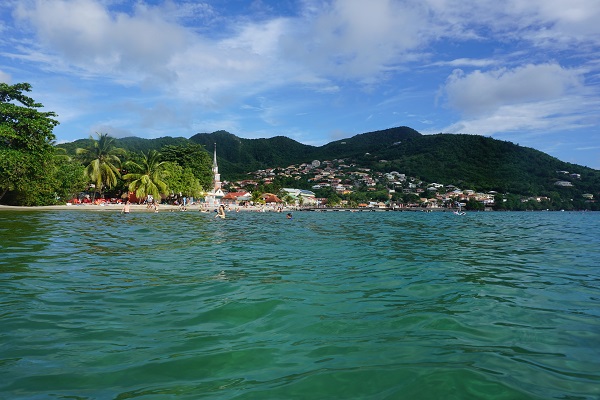
After unpacking, we headed down to the village. It is a very pretty place, with old clapperboard houses painted in bright colours, and the famous 18th century church of St Henry les Anses D’Arlet, destroyed in a hurricane in 2007 (gulp!) but rebuilt as an exact replica. The church is perfectly in line with the long jetty in the centre of town: the image of the church taken from the sea graces many a postcard. Women in dresses and hats were making their way to the church even now, as we heathens made our way to the beach.
ans 3


There were a number of restaurants with tables and chairs running right down to the waterfront, offering ‘Pieds dans L’eau’ dining – you can pitch up to any of them in your swimming costume, order your food and then go for a swim. They’ll call you when it’s ready. We took a table. It was pretty busy and the waiters were run off their feet. As in France, Martiniquans believe that eating out means a ‘proper’ lunch, that is to say, a full three course meal. All around us people were doing just that. I sometimes struggle with this concept, especially in the heat. We ended up ordering two starters, a salad and ‘Accras de Morue’ for David and ‘Accras de Vegetables’ for me. Accras are fritters, a bit like bhajis. ‘Morue’ is salted cod, shredded up and mixed with onions, garlic and spices.  A plate generally consists of 6-10 accras, accompanied by ‘Sauce Chien’, a hot dipping sauce. Why it is called ‘Sauce Chien’ (dog sauce), I don’t know. To drink, I ordered a Pina Colada WITHOUT rum, which made the waitress titter – apparently it is ‘seulement pour les enfants’. She mentioned that when she took my order, and again later when I paid.

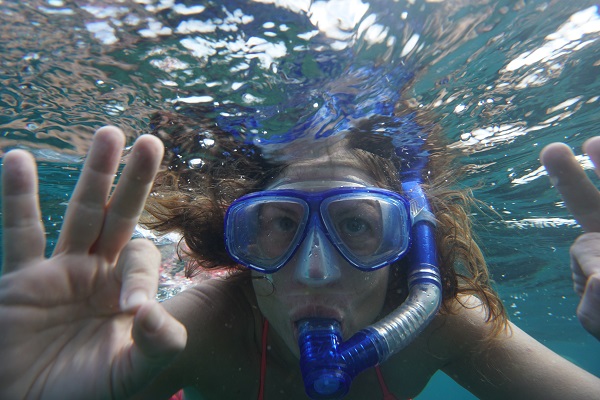
After lunch – don’t worry, mum, we did wait at least 20 minutes to digest our food! –  we put on our masks and snorkels and went for a swim. At first I was disappointed – the water was cloudy due to the fact that a river runs into it and I couldn’t see a thing. However, as we swam out, the water quickly began to clear but still, no sign of fish. Not very far out, we saw a big rock. There were quite a few people sitting on it and snorkelling round it so we headed for that. Jackpot! The rock was like a mini aquarium, swarming with colourful tropical fish. It was great for the kids, being so accessible from the beach. Anything you’ve seen in ‘Finding Nemo’ was there.
ans 2

After our swim, I lay on the beach and read my book. Nothing like a good book on the beach. Sadly, David doesn’t do lying on beaches so he went off to explore the shops – and came back with some lovely fresh Bonita (a small tuna like fish each) which he’d spotted coming in off a fishing boat.

After that, it was back up the steep, steep hill to our humble abode, where it was time for David to stoke up the BBQ while I stirred up some drinks and prepared for the Big Event. Hammock? Yes. Rum cocktail? Yep. Improbably gorgeous sunset over the Carribean Ocean? Oh, yes!  Dreams really do come true.
ans 5

Anse Figuier, Riviere-Pilote, Martinique

eco 2

Another rainy morning, so I put on my ‘what to do on a rainy day’ hat and decided to go to a museum. I had seen a sign for the Ecomusee when we were driving down, so we set off to find it. After a few wrong turns, we arrived at the beach of Anse Figuier, on the coast near to Riviere-Pilote. The museum was a huge building. There seemed to be about a dozen staff hanging around the front of the building – clearly, a government owned facility!  They seemed surprised that we wanted to come in. We paid the entrance fee and went in. It was a pleasant place, but the exhibits were somewhat dry and old fashioned, and we seemed to be the only customers. The exhibits related the history of Martinique, starting with fragments of pots and tools from the Arawaks, who were here before the Caribs arrived in about 600 AD and conquered the island. Apparently, the Caribs took the native women as wives and ate (yes ate!) the men, in special rituals which they believed passed on the power of the barbecued men. The Caribs then thrived and prospered. So apparently it works!

eco 1

Despite the arrival of the Christopher Columbus in 1493, nothing much happened until the 17th century, when the French began colonising the island, systematically wiping out the Caribs as they expanded. The colonists then did their best to make the place pay. Mangrove swamps had to be drained and malaria contended with. The museum focused on the different crops which dominated production – first sugar cane, then cocoa, coffee, cotton, tobacco, bananas, pineapples and of course rum.  The success of the plantations was down to slave labour.  Meanwhile, the French were fighting off the British and trying to quash rebellious slaves whilst dealing with a succession of natural disasters – hurricanes, earthquakes and volcanic eruptions.  Uh, oh.

Skipping forwards a few centuries, Martinique converted from a colony to a Department of France in 1946, which in theory if not in practice, means that it is totally equal to any other Department on the mainland.

After the museum, we went and sat at a table on the beach and had a delicious and very French crepe for lunch. The sun was beating down and a party of school children were having a great time playing in the sea. I was regretting our decision to leave our swimming costumes behind. Note to self: rain in the morning doesn’t necessarily mean rain all day in the tropics!

eco 6

After lunch, we decided to make a detour to Vauclin on the East side of the island. As we approached, we could see the white caps on the Atlantic – this coast is windswept and the sea can be rough in comparison to the Caribbean Sea.  Arriving at Vauclin, the town beach was covered in seaweed and had no one on it. We drove on,  taking a dirt road towards the headland of Pointe Faula. I liked the feel of this place, which had a laid back, surf-style vibe.  It is undeveloped but there’s a kitesurfing and windsurfing centre and a scattering of beachside shops and restaurants. The strong winds and shallow sea protected by coral reef make it ideal for watersports. There is also a bandstand, the location for a weekly jazz concert. Spotting a surfer shop, I dived in to buy a new bikini. Those who follow this blog may recall that I already purchased a bikini in the South of France. I liked the fact that it was black and understated, even if I didn’t like the price tag. Sadly, I left it on the washing line in Italy. I found a bikini but the price tag, unfortunately, was just the same as the last.  Nothing subtle about this one – it is dayglo orange (or dayglo pink according to David). I don’t think they do understated in Martinique.
 

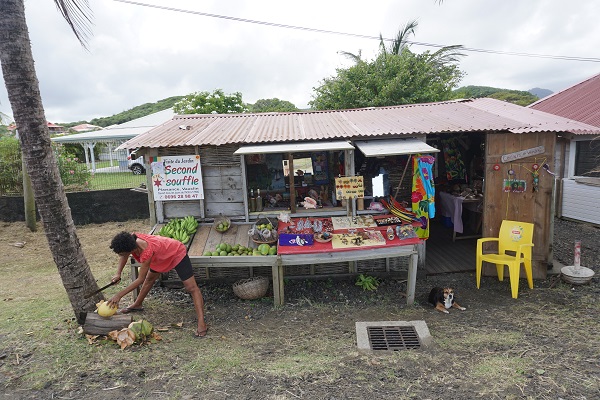
We spotted a stall selling local fruits and requested a coconut. The woman was very friendly and eager to practice her English as she told us about the fruits and spices on her stall. We ended up buying a coconut, which she prepared for us to drink there and then. When we’d finished drinking it, she made a spoon from the husk and we scooped off the delicious jelly from inside the young coconut. We also brought some Pomeloes (yes, that’s what those green fruits we were given in the forest garden were). She slipped a few leaves of a beautiful smelling dried spice called Bois D’Inde (Allspice) into the bag. Apparently, it is a popular ingredient in a lime marinade for fish.

eco 4

Driving away from Pointe Faula, we were hailed by a couple of fisherman waving something at us. Vegetarians, look away now. It turned out to be a spiny lobster small, red and with no claws. We had a fun time bargaining with the fishermen in our rough French and ended up buying a kilo. We ate them that night and they were delicious, more like langoustine than lobster.

eco 3

Savane des Petrification, Martinique

sal 6

In my blog ‘Saturday Night’s Alright’, I said I was determined to return to Les Salines and find out what was on the other side of that bridge. Well, today, we did just that.
It had been raining, not English drizzle, but heavy tropical downpours and we hadn’t stepped out the Airstream all day. It was now about three in the afternoon, and it would get dark in three hours. The rain started to slow, so I hustled David into the car and we drove down the pot holed road to Les Salines. The pot holes were now mini lakes. The craft sellers were gone, and there was no one on the beach.

sal 7

As soon as we stepped onto the path, we hit our first challenge. To continue, we would have to ford a mini lake. Actually, it was more of a river, flooding out the mangrove swamp towards the sea.  So it was off with the walking boots and into the wet boots (fortunately we had brought to help us get over the bridge – always be prepared – dib, dib, dib!) The intention was to change back into the walking boots once we were over the bridge. However we spent more time sloshing through water than we did on dry land, so it was wet shoes all the way.

As we emerged from under the trees, a rumble of thunder echoed through the woodland. The wisdom of continuing was discussed and I told David about an English man I met a few years back. He had been running across Highbury Fields in the rain, holding an umbrella when the umbrella was struck by lightening. He suffered severe nerve damage which left him with a Parkinson-like tremor.  Fortunately we didn’t have an umbrella but the fact that we were out in the open, on a headland, wading through water did seem somewhat foolish. David agreed – and revealed that he’d seen a flash of lightening a few moments before. However, the bridge was now in sight and we wanted to see what was on the other side, so against all logic, we pressed on.

sal 8

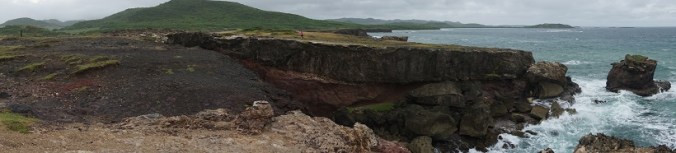
I had done a bit of research and now knew that the bridge was part of an old salt works, taking salt from the salt pans inland (hence ‘Les Salines’). Getting over the bridge was a challenge as the current was running faster than last time. And it was raining again. Once over the bridge we entered an area known as the ‘Savane des Petrifications’ (‘The petrified Savannah’ –  owing to the fact that fossilised tree remains were found here – unfortunately they have been pillaged over the years). Petrified would have been an appropriate response as we came out into the open to witness a flash of lightening – but for some reason, I couldn’t stop laughing. There was a touch of a Scooby Doo adventure about this walk. The skies grew dark.  Black slabs of volcanic rock dropped off to rough seas as we approached ‘Pointe d’Enfer’ (Hell Headland – like, yikes!), which looked out over an enormous rock rising out of the water – the ‘Table du Diable’ (Devil’s table).  The mangrove swamps gave way to an almost lunar landscape.  Desert like plains stretched out before us, dotted with tall cactus plants. We were the hapless kids, meddling  where we shouldn’t oughta. Where was the evil henchman and what was his plan?

sal 9

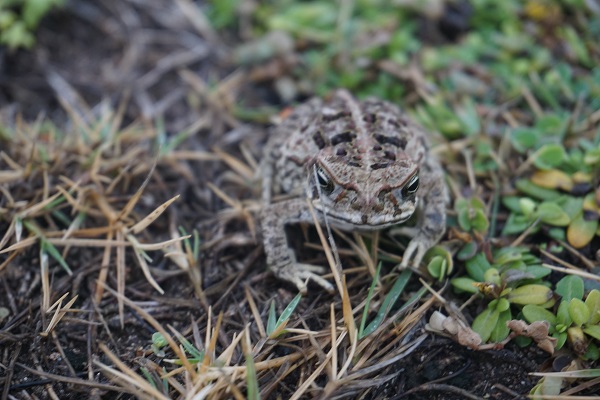
The end of this story is a damp squib. We made it back safely. No one got struck by lightening. There was no evil henchman, or at least none that we saw. Just us, a billion crabs and a few toads.

sal 10

Le Marin and Le Morne Gommier, Martinique

gomm 5

After the success of yesterday’s excursions, we decided to visit Le Marin, a town just to the North of St Anne’s. We got out at the Port and wandered around, amazed by the number of yachts moored up. There were a couple of cool looking restaurants, but otherwise the area seemed run down with a slightly dodgy feel. There weren’t many people about, apart from four tourists toasting themselves on an uninspiring beach and a large woman sitting on a stool outside a cemetery selling something mysterious wrapped in brown paper – incense, perhaps?

gomm 2

We drove on from Le Marin and on impulse took a small road heading away from the sea, into the interior. We found ourselves climbing a very steep hill, through a residential area with great views of the sea. Gradually the houses dropped away as the road began to narrow and twist and turn, becoming dense with green trees and foliage. We were in the rain forest!  A sign appeared for a view point, so we decided to risk the possibility of break failure/head on collision and continue on up. After a (mercifully incident free) few minutes we finally reached the top and pulled into a bijou car park. A sign informed us that we were on ‘Le Morne Gommier’ (Morne is an old French word for ‘small mountain’.)  There was another sign informing us that if we wanted to walk up to the 360 degree viewpoint, the price would be four euros. Ah well, why not?

gomm 4

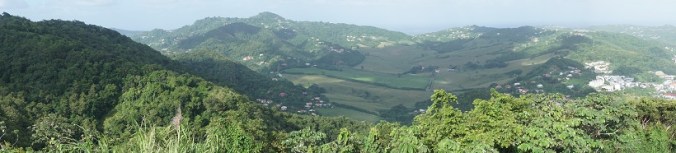
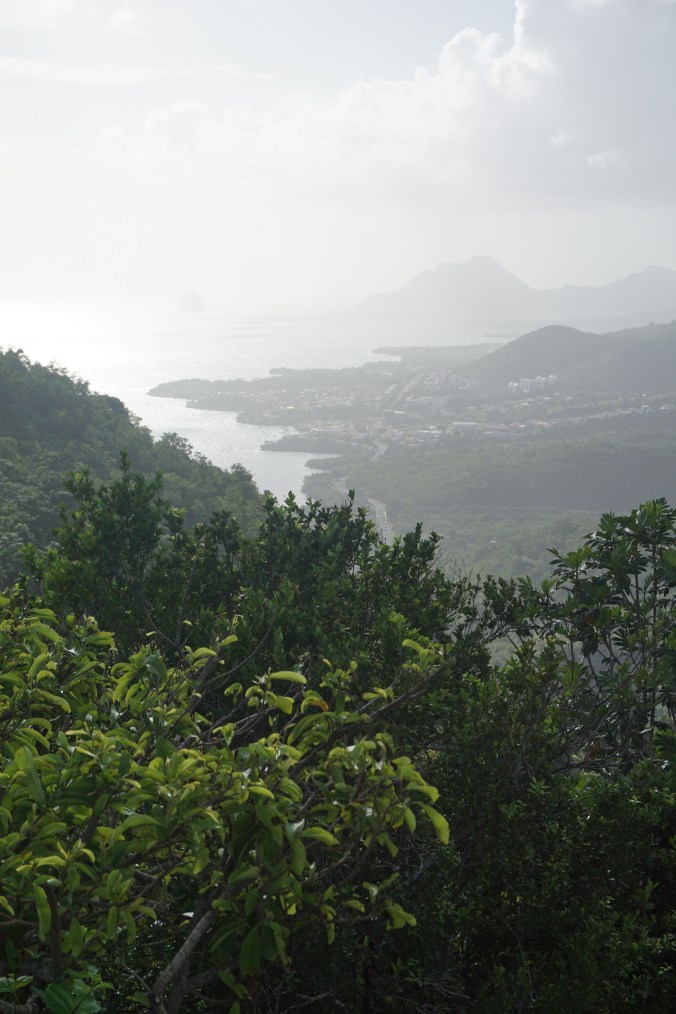
A small path lead us through a gate and into an attractive garden. Near the top was a hut, in which an elderly couple and a younger woman sat waiting to take our fee. A couple of minutes later, another party of tourists arrive eager to go to the viewpoint. The young woman lead us up there and started to talk us through what we were seeing. I struggled to concentrate on what she was saying, partly because it was in French, but mainly because the view was amazing. In one direction was the coast we had just driven from, with Le Marin in the foreground and our beach beyond that. If the weather had been clearer, we might have been able to see all the way to the island of Saint Lucia.  In the other direction, the gorgeous dip and rise of the rainforest and beyond it the rest of the island, rising up to Montagne Pelee, the volcano which erupted in 1902, destroying the capital St-Pierre entirely and killing 30,000 people. It is the worst volcanic disaster of the 20th century.  The range runs along the skyline and is known as ‘la femme couche’ because it looks like the silhouette of a woman lying down.

DSC01008

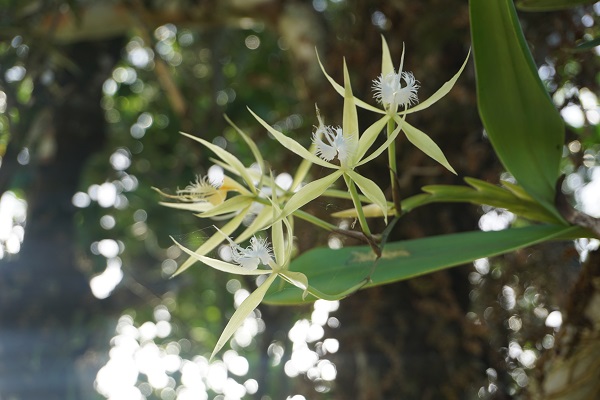
Having seen the view, we were preparing to leave when the older woman offered to show us round her garden.  We accepted, and were treated to a not always comprehensible but very enjoyable tour (in French, of course!) taking in the myriad of native fruits, vegetables, herbs and flowers which she was growing. Amongst them were vanilla pods, coffee beans, cocoa, tamarind, oranges, and a mysterious green fruit which she gifted to us. We had it for breakfast the next day and it was delicious, rather like a sweet grapefruit. Pity I can’t recall the name! She also gave us some leaves to make herb tea with and let us try a flower which was peppery like a radish. Some of the plants were for healing stomach conditions or treating cuts. She was a lovely lady, bursting with pride in her garden and eager to conserve the wonderful variety of plants native to Martinique. Thanks to her, I’m keen to spend more time in the hills.

gomm 1


Grande Anse des Salines, Plage de Pointe Marin and Etang des Salines, Martinique

sal 1

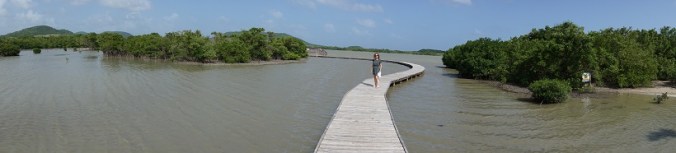
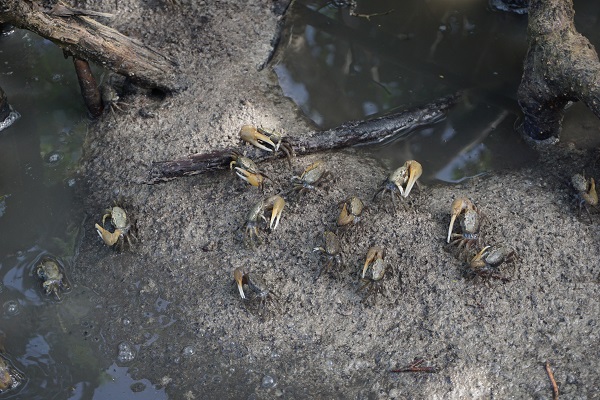
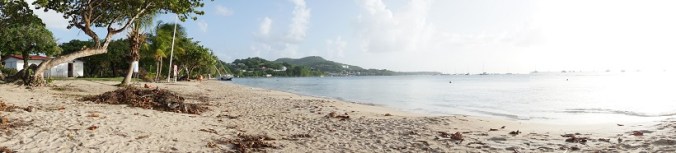
After a morning relaxing on the beach, we decided to venture out and explore the area. We drove down to the Southern tip of the island, arriving at the beach of Grande Anse des Salines. The beach was spectacular, a bit more wild than our own Plage de Pointe Marin, with a few waves. A number of stallholders in traditional dress were selling local bags, hammocks, tablemats and so on. All along the beach were picnic tables in the trees, and most of them were occupied by large family parties enjoying a picnic for the weekend. The men were lighting barbecues and hacking coconuts down from the trees with machetes. The women were unloading saucepans of food and jugs of rum punch. We saw a sign for the Etang des Salines, and followed it to a huge brackish lake which was conserved as a nature reserve. A long pontoon took us out to an observation post, a strong wind blowing across the lake There were crabs everywhere, quite small but wielding one massive claw as they disappeared into holes in the sand. Frigate birds soared overhead, looking somewhat menacing with their distinctive wings silhouetted against the sky.

sal 3

We walked away from the beach, following the road until it became a trail cutting through a mangrove swamp. There were a scattering of locals camping in the woods, and in true French style, public showers and toilets were provided. We had rounded the Southernmost tip of the island and were now walking alongside the Atlantic with a view of Ilet Cabrits, a small uninhabited island with a telecommunications tower. We tried to walk along the beach and narrowly avoided a soaking. The sea was rougher here and the waves bigger.

sal 2

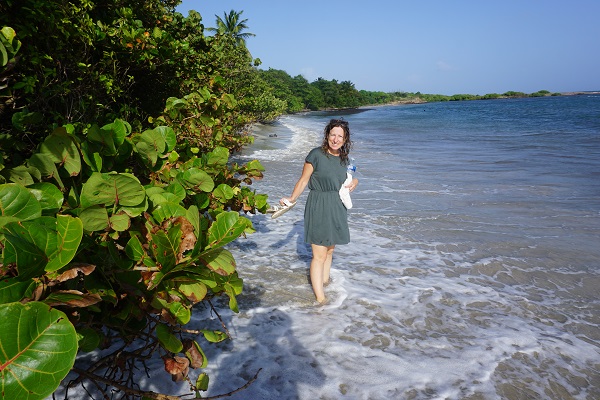
The tide was coming in. We came to a bridge which could only be reached by climbing across rocks which were under water. I couldn’t resist making the climb. David was more sensible and stood taking photos, chuckling gently.  I made it, and managed to keep my dress dry, but my pants didn’t fair so well. Fortunately there was no one around to see  – and rest assured, the photo evidence has been destroyed! By now we were hot and dying for a swim, so we returned to Grand Anse des Salines, vowing to come back another day and find out what’s on the other side of the bridge.

sal 4

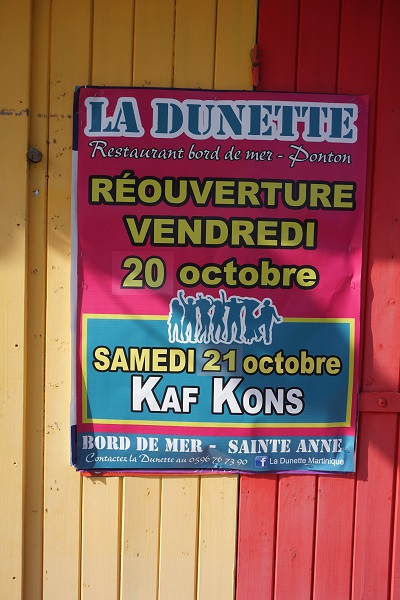
Buoyed by the success of our trip, we decided to venture out again that evening. After all, it was Saturday night! We walked round the beach in the dark (and it was very dark! There is less artificial lighting here than we’re used to.) until we reached a set of steps which took us to the edge of the small town of St Anne’s, where we went shopping the day before. In town, we noticed a commotion at a door. A man was selling tickets for a band called ‘Kaf Kons’. We decided to chance it and brought two. Ten euros a piece for a drink and a band. At the bar, we were given a very strong drink called  ‘Ti Punch’, made of rum, sugar and lemon. Inside, the band were setting up. The dance floor was surrounded by tables of people eating. Clearly a meal, a drink and a band was a popular option. We opted to take our drinks out onto a pontoon strung with lights. We sat at the end of the pontoon, watching tenders ferrying people to and from yachts which were moored in the bay.

Time went on and still no sign of the band. However, the place was filling up so we moved to some seats on the edge of the pontoon with a great view of the dance floor. It was varied crowd. To one side of us, a party of women in their sixties, white, dressed up to the nines in sparkly shorts and high heels. On the other, a mixed race couple who couldn’t keep their hands off each other. Behind us, a small, shaggy haired white man couldn’t sit still – he kept rolling spliff after spliff. There were several kids running about, excited to be allowed up.

The band started up, and immediately, three or four couples got up to dance. Despite the up tempo nature of the music, they were all dancing ‘cheek to cheek’, snaking their hips Samba style. Perhaps they’ve been watching ‘Strictly’? As the evening wore on, the numbers on the dance floor swelled until it felt like everyone was dancing. I even managed to drag David up. Fortunately for us, ‘Samba style’ dancing was not required, but it was definitely in favour. A grey haired black man was mesmerising to watch as he swung woman after woman around the dance floor, his hips snaking left and right.  A thin-as-a-rake Rasta seemed happy to partner any woman of any size, shape or age, as long as she was white. At exactly the same point in every dance, his hands would slip down to her bottom.

The band played a wide variety of styles. Some of them were super cheesy covers like ‘D.I.S.C.O’ but they covered everything from Nina Simone to Pharell Williams. And they never took a break! We left at midnight, by which time they had been playing for two and a half hours. People were still arriving.

sal 5

Airstream Paradise, Fort de France, Martinique.

air 5

I wanted to blog more about our stay in Italy, the journey home via Mont Blanc in which we had a burst tyre and a stopover in a dilapidated Chateau as the only guests but sadly I have got behind and the next chapter of our year of living adventurously must begin.

Martinique.

Yes, dear readers. Try to restrain your envy when I tell you that I am now on the Caribbean island of Martinique. The temperature is a totally tropical 30 degrees. And we are here for the next six weeks!

We flew from Heathrow to Paris (Orly) yesterday and then from Paris to Fort de France, the capital of Martinique. Martinique is a Department of France, as opposed to a French colony, which is to say it is part of Europe. So we can continue to spend our Euros and speak French.  We didn’t even have to pass through customs when we arrived. The flight was classed as an internal flight.

We picked up a hire car at the airport and drove to our home for the next week. Weird not to have the Campervan! It was only 7 pm local time but it was already dark and on English time it was midnight, so we felt quite confused and disorientated. Fortunately, David had packed the Satnav, uploaded with a ‘worldwide’ programme so we didn’t have to suss out the route – and driving in France for six weeks meant that driving on the right felt quite natural.  We even managed to stop off at a supermarket (Carfour, just like in France. Wait – this IS France!)

air 1

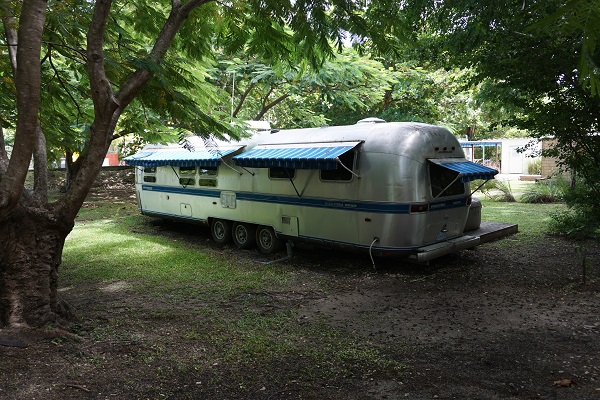
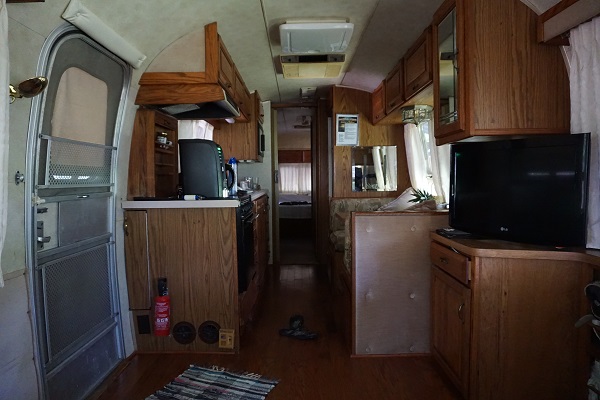
Our accommodation is situated on La Plage de la Pointe Marin, Saint Anne’s, which is on the southern most tip of the island. It is a caravan which goes by the name of Oklahoma. Caravan is a bit of a shabby word for this place – it is a super cool silver Airstream trailer on a wonderfully eccentric site called Airstream Paradise.

air 3

If you haven’t heard of an Airstream, you will almost certainly recognise one when you see it. They feature heavily in the movies. A sign in the caravan informs me that all the Airstreams here have been purchased from Warner Brothers. Our one, Oklahoma, was used in the filming of ‘Jurassic World’. They are also pressed into service as trailers for the stars on movie sets.

air 2

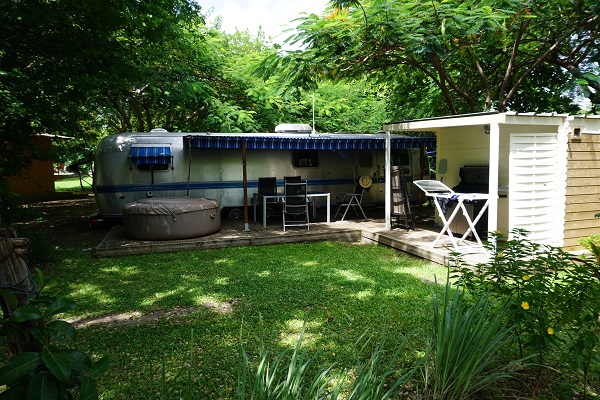
Compared to the campervan, it is seriously spacious, with a sitting room, kitchen, loo and bedroom. Outside, we have a deck with barbeque, dining area, jacuzzi, and full sized bathroom. I swanned around channelling my inner trailer queen –  Laura Dern in ‘A Perfect World’ or perhaps Kim Basinger in ‘8 Mile’. After arriving we hit the sack pretty quick. Then today we woke up to discover that we are within spitting distance of the archetypal Caribbean beach,  white sand fringed with palm trees. Move over, Laura Dern. This is the life.

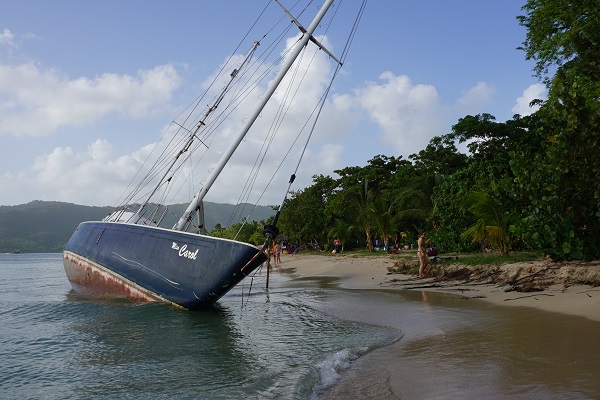
Before arriving, we were concerned about the impact of Hurricane Ophelia. The news told us that the neighbouring island of Domenica was badly hit but that Martinique got off relatively lightly. However, as soon as we hit the beach, we saw that a yacht had been blown off its mooring and was now lying on its side on the beach.  On closer investigation we saw a sign on the hull warning the owners that they have another couple of weeks to claim the boat or it will be towed away. It’s pretty clear that the yacht has no real value anymore as all the windows have been removed and anything of value has been “salvaged”.

air 4

We ventured into the local village and had a look around the shops. Rum seemed to be a bit of a theme – rum bars, rum themed T-shirts, rum flavoured food. We came across some women selling local produce and were persuaded to sample their homemade rum punch, the bottle stuffed with tropical fruits. There was also a strong French flavour to the town.  The melding of French and Caribbean culture feels quite surreal.  I saw a Rastafarian leaving a Boulangerie carrying two Baguettes.

Back at the Airstream, we sat outside for lunch, and were joined by a variety of birds and insects. At the unwelcome end are the mosquitos, which are active day and night, and at the welcome end are the birds, most notably a hummingbird dipping its beak into a hibiscus flower.

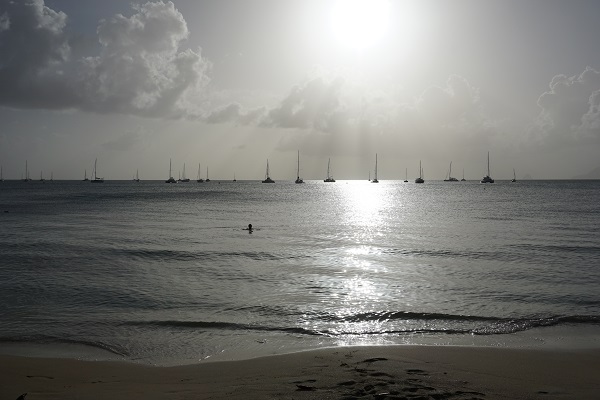
In the evening, we took a couple of beers onto the beach to watch the sunset, but unfortunately it clouded over before we could see it go down.  Crabs started to appear all along the beach, popping out of holes in the sand. David threw one a peanut and he caught it in his claw. On the way back to the Airstream, we spotted a huge toad moving at surprising speed across the path. As night fell, the noise of cicadas rose to a crescendo, but was soon drowned out by the beat of music from a bar just across the way. Of course! It was Friday night. David barbecued some Marlin and I kept an eye on the bar, but didn’t spot a single customer. We are on the cusp of the low season here, and apart from a few French tourists at Club Med along the beach,  it feels very quiet. We seem to be the only residents of Airstream Paradise. Just us, the toads, the cicadas, the lizards and the birds!

air 6

River Ombrone, Tuscany, Italy

omb 1

The French leg of our journey was over. It was time to move on. So we set the SatNav and made a beeline for Italy, where we were due to spend a week with my parents, who have restored a beautiful old farmhouse deep in the hills of rural Tuscany. It was a shock to the system, living in a house and for a couple of days I actually missed living in the van, but there were definite compensations, not least sleeping in a real bed!  And as brilliantly as David and I have got on, it was good to see my parents.The weather was beautiful, and we enjoyed exploring the countryside around the house with them  and their chocolate lab, Coco, taking small hunting tracks into the woods or skirting around the edges of fields. The views were beautiful, with rolling hills, woods and the occasional farm or hill village. Grapes had been harvested and olives were next on the calendar, but due to a particularly hot, dry summer, the locals said it was going to be a very poor harvest. Meanwhile, a new farmer had moved in next door and was preparing his fields for thousands of new olive trees.

omb 2

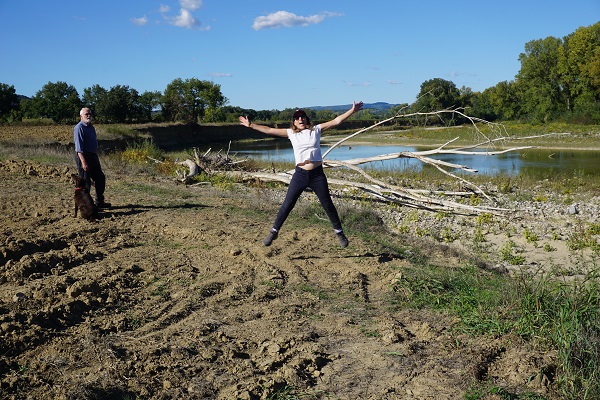
On our second day, we walked down to the River Ombrone, which at certain times of year is a huge river. Right now, the river was virtually dry, the banks towering up over our heads as we walked along the river bed.  Uprooted trees littered the landscape, bleached bone white.  It was very hot, and Coco soon found some water and waded across to the other side. My mum picked up half a walnut shell from the sand and we wondered where it had come from. On our way back, we passed a tree and realised it was a walnut tree – a squirrel had probably stolen a nut and dropped the shell down by the river.  We gathered a few nuts from the ground and took them home with us. They were very good eaten with the traditional Italian dish of pecorino cheese and pear drizzled with chestnut honey.

omb 6

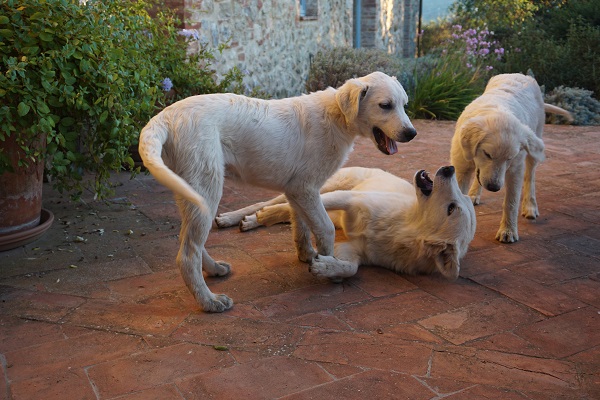
On our return to the house, a few white shapes started to move across the fields towards us. It was a pack of five or six Maremma sheep dogs. They are bred to guard the sheep from wolves, which are still found in this area. Two puppies and a dog made it up to the house and the puppies started to growl and nip Coco. She stood her ground and they soon left her alone and started to play fight each other. They are beautiful creatures, and very friendly, but I resisted the urge to stroke them – they are working dogs, not pets, and I suspect they might have fleas.

IMG_1529


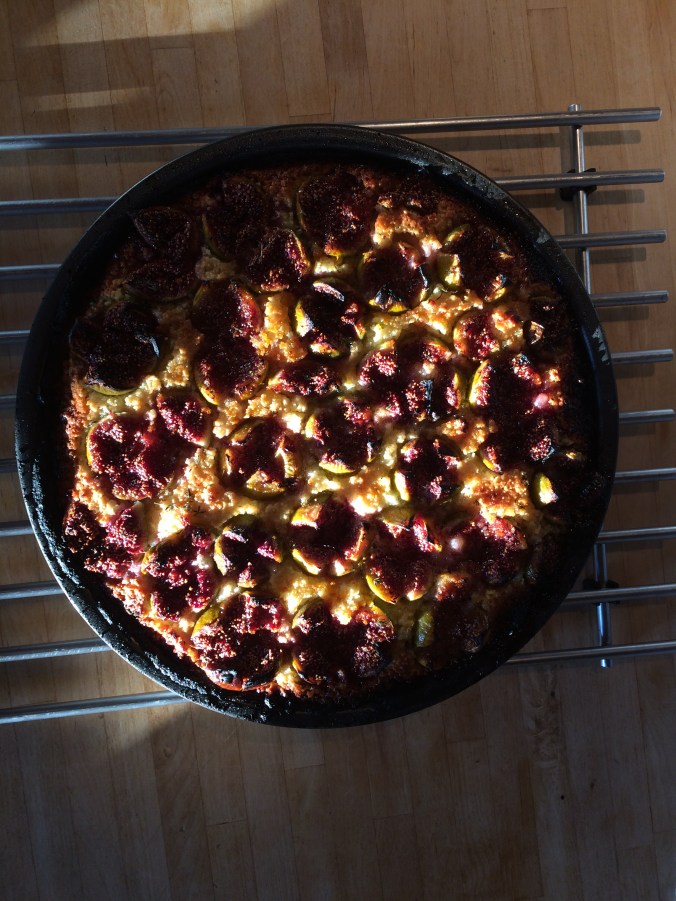
Once they were gone, I got out the ladder and set to work stripping the last of the figs from a tree behind the house. Most of them had been picked in the summer and made into jam and the remaining fruits were beginning to split and the bees were having a feast but I managed to uncover a couple of dozen good ones. David set to work making a traditional Tuscan desert, a fresh fig tart, which we enjoyed eating that evening.

omb 3


Antibes and Juan-les-Pins, France

ant 1

Antibes was our next destination. We were particularly keen to see the Old Town, which our daughter Molly recommended after visiting this summer.

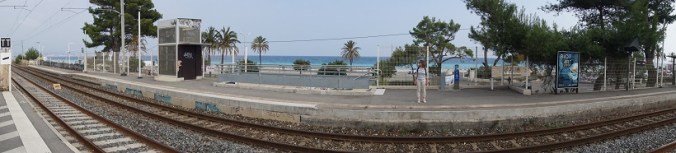
We found a campsite, La Vielle Ferme. It was close to a railway station in Biot with direct trains to Antibes. The campsite didn’t look very promising from the road but inside we found it had large, enclosed pitches and great facilities including a full size covered swimming pool, table tennis (of course!), and a popular bar/pizza joint. No toilet seats, alas, but toilet paper in every cubicle!

ant 2

We found ourselves camping next to an Italian couple with a cute little puppy called Benny.  He popped through the hedge occasionally to say ‘Ciao’. The owners continually chorused ‘Benny, veni qui’  which became a bit wearing after a few days, but aside from that it was probably our favourite site so far.

The site had a number of long stay residents, lounging outside unfeasibly large tents which were elaborately decorated with plants, framed pictures, satellite dishes, etc, etc. The site closes in Mid November and opens again just after Christmas, during which time I assume these happy campers return to whatever country they come from and show off their nut brown skin before rushing back to lounge outside their unfeasibly large tents.

ant 5


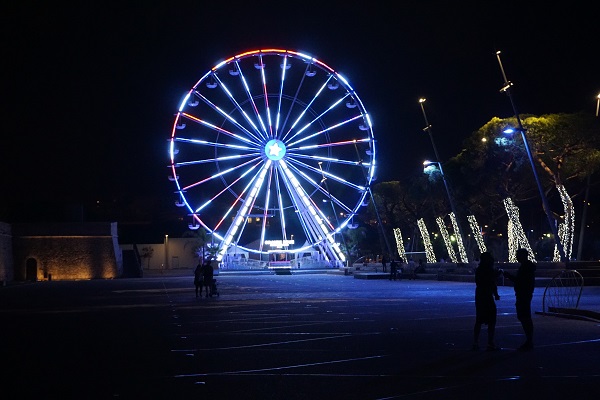
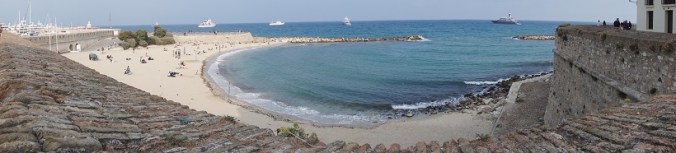
We took the train to Antibes, which was a cinch – trains were every half hour and only took five minutes –  and walked down to the Port, where there was a big wheel.  There were a number of Gin Palaces moored out to sea, so large they looked out of scale. We walked past a lovely little beach and then through an arched gate in a thick stone wall to enter the Old Town. The old town itself was very atmospheric, a walled city within a city with narrow, winding streets.  Within the old town is a medieval castle which has been turned into the Picasso Museum. Unfortunately we didn’t manage to visit it this time.  Instead we joined all the other tourists wandering about at a leisurely pace, enjoying the views across the bay to Cap D’Antibes and beyond to Juan-les-Pins.

ant 3

Spot the rhino

Another evening, we took the train to Juans-les-Pins, nicknamed the Millionaire’s Bay, and enjoyed a very expensive cocktail in one of the bars on the beach. The closer you get to the sea, the more expensive the drinks. We walked along the seafront for a few minutes and then, because it was a particularly beautiful evening, and because we never got to St Tropez, we stopped at Le Cap D’Antibes beach hotel, and had an even more expensive cocktail. A brief taste of life in the fast lane.  After that, I put myself in David’s capable hands as he lead us back to old Antibes on foot via some of the spectacular houses which grace the hills of Cap D’Antibes, and I thought I caught a whiff of the perfume of Zelda Fitzgerald…or was it Elizabeth Taylor? Antibes has long been on the ‘Must Do’ list of the international jet set.

Back in Old Antibes, we ducked into a tiny wine bar and soon found ourselves sharing plates of Corsican food. Looking about the walls,  I saw maps and flags and posters advertising Corsica.  We were served by a bilingual woman who told us that she was Canadian. This was confusing, until she explained that she had recently moved to Antibes to be with her Corsican boyfriend who was working alongside her. The excellent small plates mysteriously arrived in a dumb waiter. When I asked where the toilets were, the waitress told me ‘C’est an adventure’. I pulled a handle and what looked like an ancient linen cupboard slid back revealing a loo. At the end of the meal, our waitress offered us a complementary Limoncello, despite the fact that this was the best value meal we’ve had in France. If you’re in Old Antibes, I’d like to recommend you go there but unfortunately I didn’t note down the name. I’ll see if I can find it online.

ant 4

Domaine du Rayol, St Tropez and St-Maxime, France

SM 1.jpg

Our next destination was St Tropez, a beach resort synonymous with Bardot, the sixties, the rich and the famous, but what would it be like off season? Would all the beautiful people have gone back to Paris, New York and Rome or would the Autumn sunshine keep them hanging on…?

One advantage of the off season was the lack of traffic and we decided to stick to the coast road. Good decision. We wound through pretty villages, the steep hills to our left lush with tamarisk, olives and eucalyptus, whilst to our right we caught glimpses of hidden beaches and beyond them the sparkling sea. From time to time we would encounter clusters of lycra clad cyclists, and even the odd group of hunters replete in dayglo jackets with dogs and shotguns. In the village of Rayol we stopped to look at the view and accidentally found ourselves in the Domaine du Rayol,  a beautiful garden which runs right down to the sea. I gather it was first established by a Parisian banker returning to his home town in 1910 and has been extended from there.

SM 2

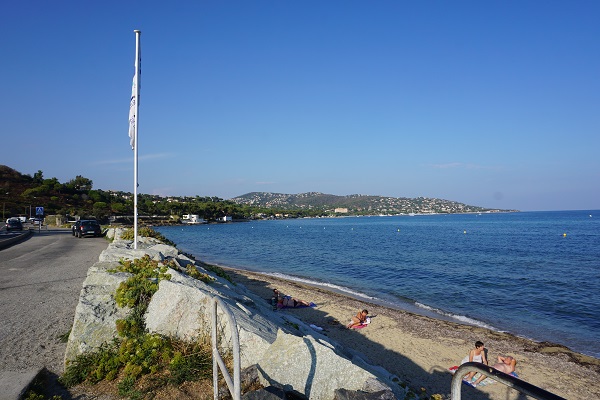
As we came closer to St Tropez, we started checking for campsites and realised that we weren’t going to be able to get very close. So instead we decided to head to Camping Les Cigalons, just beyond St-Maxime, which looks across the bay towards St Tropez. The nice thing about Les Cigalons was that it was just across the road from a public beach. In this part of France, a lot of the beaches are privately run and you have to pay to use them so a public beach was a good find.

SM 5

The pitches were rather cosy and we found ourselves sandwiched between a Dutch caravan and an English Motorhome. The English had really spread out, with what looked like a full three piece suite out front.  They also had a dog, two electric bicycles and were towing a small car, so we felt a bit squeezed out.  And also, they didn’t smile. The Dutch, by contrast,  came and shook hands and told me they were heading to Spain for the Winter. They also said they liked our van!

The campsite owner was very laid back. He asked us to find our own pitch and didn’t bother asking how long we planned to stay. He had a round table and chairs set up outside his office where he received a steady stream of visitors. His social life started at 11 am with a glass of beer and graduated at 12 to wine and a long lazy lunch. The afternoon was taken up with Petanque, and perhaps a glass or two of Pernod.  I wondered if he was making up for lost time, having spent all July and August working his socks off. Or perhaps it was just how he rolled.

The first thing we did after setting up was go down to the beach. It was only a narrow strip, but the sea was really sheltered and warm.  I was soon swimming out to sea, in my element. I noticed there were a lot of yachts. I found out later that it was almost time for  ‘Les Voiles de St Tropez’, a big event in the yachting calendar which sees ordinary yachts racing side by side with so-called ‘Maxi’ yachts. These Maxi yachts are monstrous with big black sails and when one appeared round a headland, it gave me quite a shock.

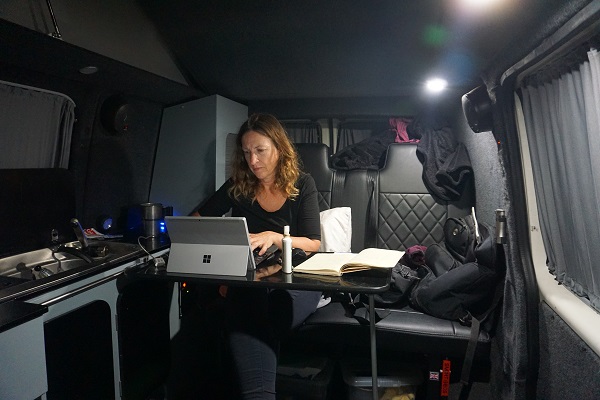
Because I had a script to write, we ended up spending five days at Les Cigalons. I would work all day at the table in the van until about 4 pm and then hit the beach for a swim.  David was still keen to go to St Tropez. There was a bus stop just outside the site but the buses were impossible to predict – the timetable on the bus stop was hidden behind scratched plastic and we couldn’t read what it said. He walked into St-Maxine to try and hire a motorbike, but despite combing the town, he couldn’t find a hire place.

SM 4

The following evening, we walked into St-Maxine, three or four kilometres walking by the side of the coast road. The road was fast and noisy but the sunset was beautiful as it set over the sea and was succeeded by an almost full moon. Perhaps I’ve been spoilt by all the beautiful places we’ve seen, but St-Maxine didn’t grab me. There  was a strip of overpriced ‘white tablecloth’ restaurants on the promenade, one with a live trad. Jazz band. We gave them a miss and opted for a pizza and a glass of wine in a ‘red and white tablecloth’ bistro set on a pretty square.

On our last evening, we walked the other way up the beach, away from St-Maxime, and came across a jetty with boats going every hour to St Tropez. The ticket office was shut, but we came back the next morning, excited to catch the boat.  However, on arrival, the ticket office lady informed us that the previous day had been our last chance as the boat service was now closed for the season.

So, despite our best efforts,  we never got to St Tropez.

SM 3


Cassis to Hyeres, France

hye 1

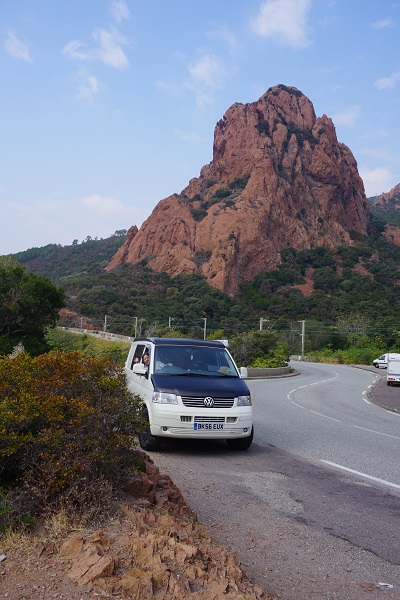
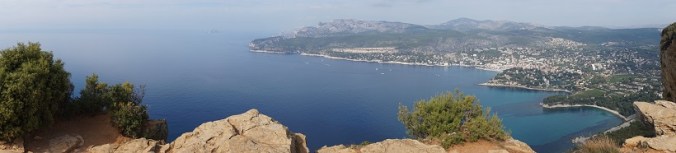
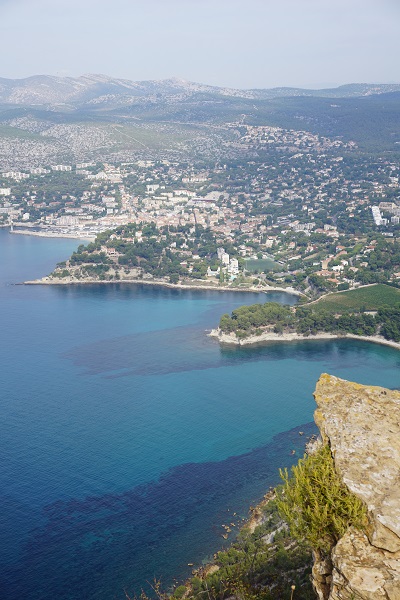
The drive from Cassis to Hyeres was spectacular. An hour of twisting, turning road clung to the edge of the cliff, with incredible views of Cassis and Les Calanques. David kept stopping the van to take photos as every corner revealed another more stunning vista. He wasn’t alone. There were cyclists and motorbikes and car drivers, all doing the same thing.

hye 3

Arriving at a campsite just outside Hyeres, which was billed as an elegant, once fashionable beach resort in our guidebook, we found it had a very different feel from Cassis. When we asked if there were any spaces, the woman behind the desk just laughed, ‘Take your pick’.

hye 6

There were only a handful of customers in the whole place. The shop was closed and so was the café. The site was due to close in a few days. We weren’t overly impressed with the place, but resolved to stay put, as we both had some work to catch up on and (for once)  WiFi was free with a good connection.

hye 5

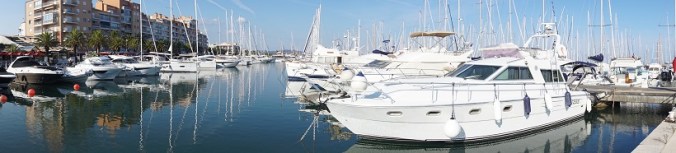
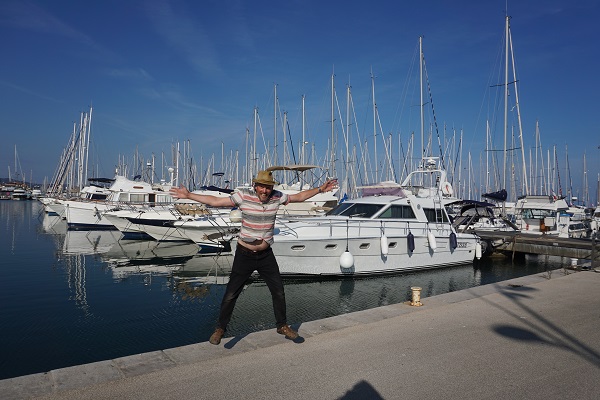
Hyeres itself was out of reach on foot but we walked to the marina. There were numerous chandleries and the marina was full to bursting, with a good many impressive yachts. Hyeres, we discovered, is a major centre for yachting, with a long association with the America’s Cup.

hye 2