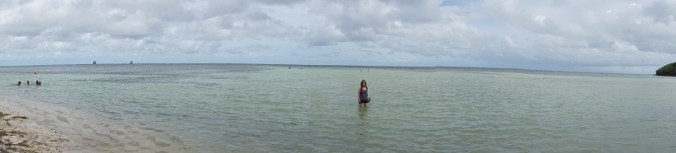
Another rainy morning, so I put on my ‘what to do on a rainy day’ hat and decided to go to a museum. I had seen a sign for the Ecomusee when we were driving down, so we set off to find it. After a few wrong turns, we arrived at the beach of Anse Figuier, on the coast near to Riviere-Pilote. The museum was a huge building. There seemed to be about a dozen staff hanging around the front of the building – clearly, a government owned facility! They seemed surprised that we wanted to come in. We paid the entrance fee and went in. It was a pleasant place, but the exhibits were somewhat dry and old fashioned, and we seemed to be the only customers. The exhibits related the history of Martinique, starting with fragments of pots and tools from the Arawaks, who were here before the Caribs arrived in about 600 AD and conquered the island. Apparently, the Caribs took the native women as wives and ate (yes ate!) the men, in special rituals which they believed passed on the power of the barbecued men. The Caribs then thrived and prospered. So apparently it works!
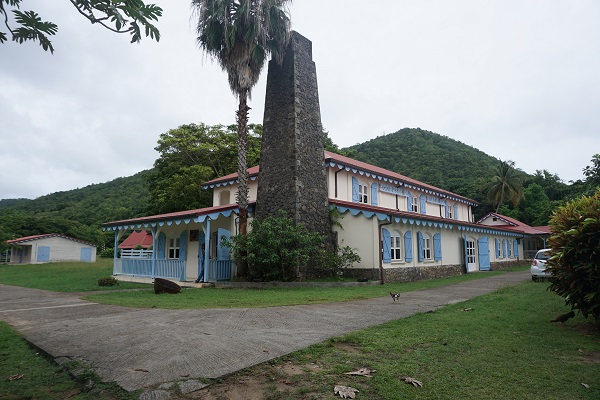
Despite the arrival of the Christopher Columbus in 1493, nothing much happened until the 17th century, when the French began colonising the island, systematically wiping out the Caribs as they expanded. The colonists then did their best to make the place pay. Mangrove swamps had to be drained and malaria contended with. The museum focused on the different crops which dominated production – first sugar cane, then cocoa, coffee, cotton, tobacco, bananas, pineapples and of course rum. The success of the plantations was down to slave labour. Meanwhile, the French were fighting off the British and trying to quash rebellious slaves whilst dealing with a succession of natural disasters – hurricanes, earthquakes and volcanic eruptions. Uh, oh.
Skipping forwards a few centuries, Martinique converted from a colony to a Department of France in 1946, which in theory if not in practice, means that it is totally equal to any other Department on the mainland.
After the museum, we went and sat at a table on the beach and had a delicious and very French crepe for lunch. The sun was beating down and a party of school children were having a great time playing in the sea. I was regretting our decision to leave our swimming costumes behind. Note to self: rain in the morning doesn’t necessarily mean rain all day in the tropics!
After lunch, we decided to make a detour to Vauclin on the East side of the island. As we approached, we could see the white caps on the Atlantic – this coast is windswept and the sea can be rough in comparison to the Caribbean Sea. Arriving at Vauclin, the town beach was covered in seaweed and had no one on it. We drove on, taking a dirt road towards the headland of Pointe Faula. I liked the feel of this place, which had a laid back, surf-style vibe. It is undeveloped but there’s a kitesurfing and windsurfing centre and a scattering of beachside shops and restaurants. The strong winds and shallow sea protected by coral reef make it ideal for watersports. There is also a bandstand, the location for a weekly jazz concert. Spotting a surfer shop, I dived in to buy a new bikini. Those who follow this blog may recall that I already purchased a bikini in the South of France. I liked the fact that it was black and understated, even if I didn’t like the price tag. Sadly, I left it on the washing line in Italy. I found a bikini but the price tag, unfortunately, was just the same as the last. Nothing subtle about this one – it is dayglo orange (or dayglo pink according to David). I don’t think they do understated in Martinique.
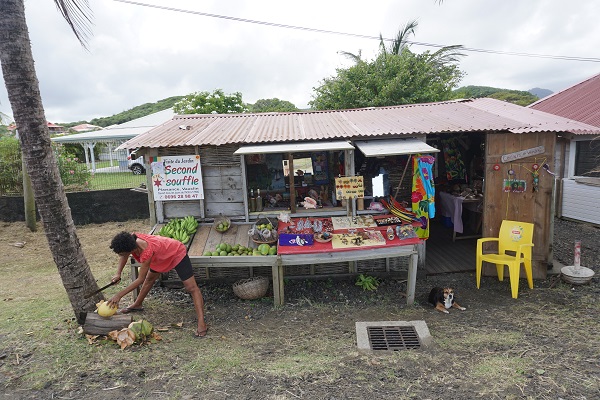
We spotted a stall selling local fruits and requested a coconut. The woman was very friendly and eager to practice her English as she told us about the fruits and spices on her stall. We ended up buying a coconut, which she prepared for us to drink there and then. When we’d finished drinking it, she made a spoon from the husk and we scooped off the delicious jelly from inside the young coconut. We also brought some Pomeloes (yes, that’s what those green fruits we were given in the forest garden were). She slipped a few leaves of a beautiful smelling dried spice called Bois D’Inde (Allspice) into the bag. Apparently, it is a popular ingredient in a lime marinade for fish.
Driving away from Pointe Faula, we were hailed by a couple of fisherman waving something at us. Vegetarians, look away now. It turned out to be a spiny lobster small, red and with no claws. We had a fun time bargaining with the fishermen in our rough French and ended up buying a kilo. We ate them that night and they were delicious, more like langoustine than lobster.
 Senior gap year
I love it so much
LikeLiked by 1 person
Thanks, Em!
LikeLike