
Exciting day today – the first day of our dive course with Alpha Plongee, a dive school based at Grand Anse Plage. Our first dive was booked for 10 am. Grande Anse is just around the corner from Anses d’Arlet, so we set off about 9.30, which gave us plenty of time to get there and find a parking space before we paid up and got our gear on. However, on leaving the house, we found that our road was completely blocked off and a new, more extensive diversion was in place – only trouble was, they hadn’t bothered signposting the route of the new diversion. After an anxious few minutes of wrong turns and dead ends, we finally found our route – which took us in the OPPOSITE DIRECTION from where we wanted to go, UP the impossibly steep hill, twisting and turning sharply beyond the houses, right into the forest – before finally descending back down to the main road. We hurried into the dive centre just before 10.
Fortunately the dive school dudes were cool and laid back (as dive school dudes are) and gave us plenty of time to get our act together. I’ve been diving a few times before, but only on try dives, where everything is laid on for you. So it was a new experience for me to have to connect up my oxygen tank, attach it to the life jacket and make sure everything worked. I felt my first pang of apprehension. The idea of being underwater and seeing all the sealife was hugely attractive, but I was intimidated by the ‘technical’ side of diving – would I be up to this? Would I be safe?

It was time to go, so we headed for the water, burdened by the weight of our equipment. As soon as we entered the water, the weight of our tanks was eased. Then it was on with the flippers and swim out to our boat – not too far to go. Once on board, we powered round the corner to the cliffs on the West side of the bay. David and I were paired up with a couple of kids and an instructor. The aim of the dive was to get us used to being underwater, to learn how to use our breath to make us go up and down, and and to remind us not to flap our hands about! The instructor explained that the kids were more experienced than us and would show us how it was done. David has dived a bit more than I have so I was acutely aware that I was the least experienced one there.
What lies beneath
Soon we were descending, going down about 11 metres. It took a bit of time to get used to the fact that I could only breath through my mouth, and the sound of my breathing reminded me of the soundtrack of a bad horror movie. Which inevitably made my imagination run away with me. It doesn’t help when your diving instructor has warned you that you mustn’t forget to breath “or your lungs will explode and you will die”. The kids, meanwhile, were darting about like maniacs with no fear at all. The instructor was very kind and stayed glued to my side until I started to relax a bit and look around.
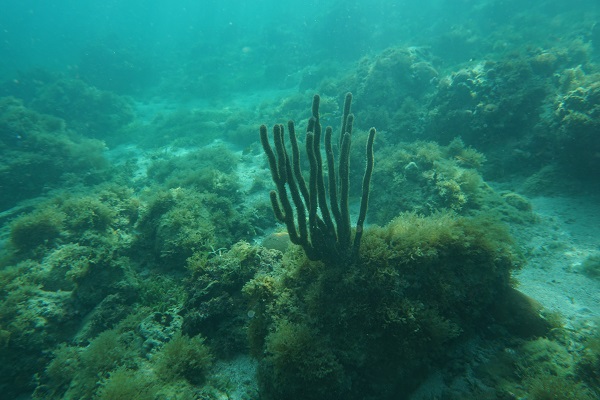
It was beautiful. The variety of corals was incredible, the best I’ve ever seen. My ignorance of coral names is complete, but I saw delicate fan-shaped corals, massive ‘brain’ corals, tube corals, stag antler corals, and corals that looked like giant pots, often with fish hiding within. Then there were the fish – trumpet, puffer, angel, spotted scorpion – in shoals or on their own. Everything was waving about, and in a fantastic array of colours. Sometimes something would turn out not to be a coral but a sea cucumber or worm/snake type thing. To those who know better, I apologise for the poverty of my ‘underwater’ vocabulary, I’m working on it!
The weirdest moment of the dive was when we came up. I genuinely thought we were going down, not up, until my head popped out of the water. We’d been down there for 45 minutes, but it felt much shorter.
Into the abyss
Once we got back to the dive centre, we just had time for a quick lunch and then we went out again. This time we went down to 14 metres – the deepest either of us had been. To get to the dive, the instructor told us we had to go down to the bottom of the sea and stick low to avoid the currents.
Towards the end of the dive, we came to a rope which we held onto while performing a couple of exercises. First we had to take out our regulators (breathing tubes) and breath out slowly for a time before putting them back in again. Then we had to take off our masks completely and then put them back on again. We had rehearsed these on the boat before we came down, but it was much more daunting at 14 metres. The mask moment was particularly scary for me as a contact lens wearer. Fortunately, the instructor agreed to let me keep my eyes shut when the mask came off – my eyes still stung from the salt when I got the mask back in place – but at least the lenses stayed in place. I hope my optician isn’t reading this, she would be horrified! Anyway, we both ‘passed’ that bit of the course and on the way back up to the surface, we got our reward – a turtle, diving a few feet over our heads.
We headed back to the dive centre feeling knackered but exhilarated – and immediately booked ourselves in for the rest of the course. We’ve opted for one dive a day from this point on, as two in one day is surprisingly hard work.
 Senior gap year