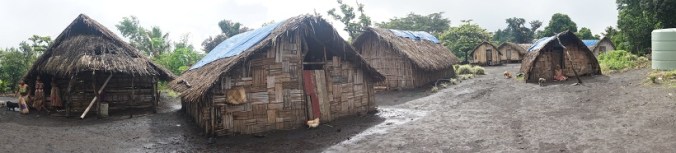
Today, we were taken to the Ipai Kustom Village. This is a village where the traditional way of life is still observed. Tom was away so his father drove us up there, and Tom’s daughter came along for the ride. We drove for about 20 minutes up a narrow, rutted earth track, sliding and stalling and bumping the axle on the ground. As we drove up, we talked about what to expect. We figured it would probably be a bit of a tourist trap, put on for visitors.
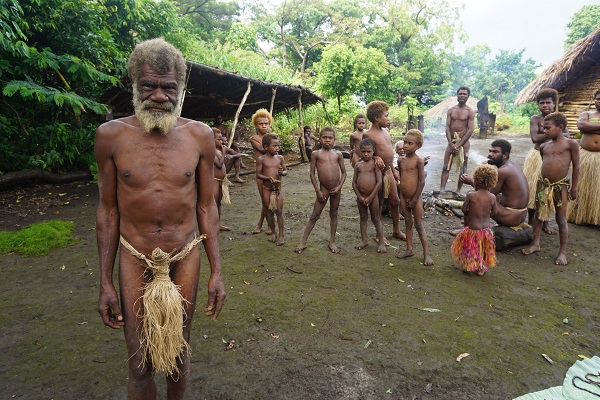
Eventually we arrived. Through the trees, I spotted a woman sitting in the door of a traditional hut breast feeding a baby with piglets and dogs running about her feet. A group of children crowded round us, some naked, some wearing nambas (penis sheaths) or grass skirts for the girls. A Ni-Van in shorts and T-shirt shook our hands and said he would be leading the tour. The Ipai speak their own language and don’t have much English so without the guide it would be difficult to communicate.
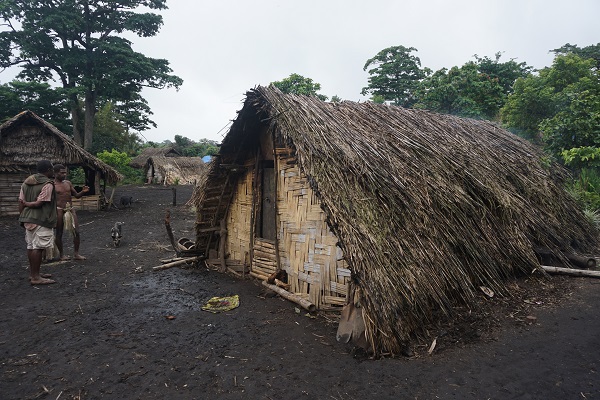
The tour began with a walk through the ‘gardens’ of the Kustom village. The crowd of kids followed shyly behind. Our guide pointed out the various plants and trees, which are used for food, medicine or construction of tools and houses: everything has its use. The people of Ipai are entirely self sufficient, with the exception of water which sometimes runs dry in the summer – then they have to ask for outside help.
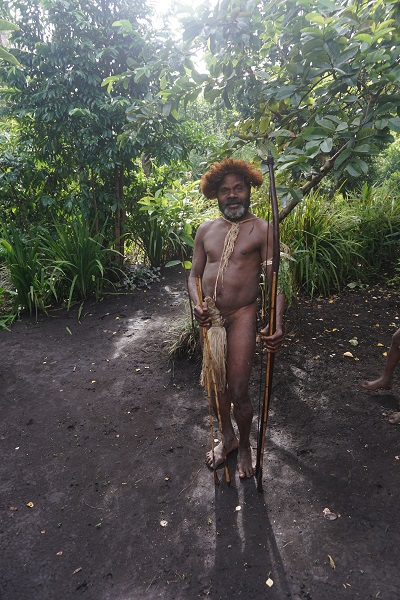
The first stop on the tour was to meet a hunter who, like all the men, was dressed in only a namba. He shook our hands, grinning from ear to ear. He demonstrated his skills with a bow and arrow and with a spear, and invited David have a try. The ‘great white hunter’ acquitted himself quite well with the bow and arrow but when it came to the spear, he couldn’t hit the target. A boy of around ten was invited to have a go and hit the target first time!

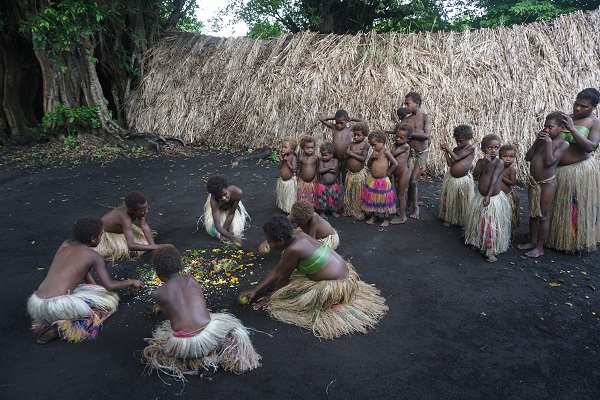
After the hunting display, we moved on to a clearing, where some girls demonstrated a traditional game. The game involved singing and passing oranges round the circle. When the song came to an end, the aim was that each girl should have an orange – no girl should have two. This teaches the children to share. If you go to the forest and gather two breadfruits, you should keep one and give the other to your neighbour.
After the game, we moved on to look at the village. There was a old, traditional hut which is lower and more stable than the modern huts. Apparently, during Cyclone Pam, the 100 villagers all gathered in the traditional hut, which didn’t blow down. It began to rain, so we ran to the women’s hut, where some of the older women were making lap lap. Lap lap is made with yam, cassava, plantain, bread fruit or sweet potato that has been grated and topped with coconut milk, then wrapped in banana leaves and roasted under hot stones. I tasted some bread fruit lap lap and thought it quite tasty! After that, I was invited to stay in the women’s hut and be prepared to join in with the traditional dances. It was a very special experience to be pampered by the women. I was kitted out in a beautiful, colourful grass skirt and had day-glo face paint applied to my face. I couldn’t understand what they were saying but there was plenty of giggling and I kept hearing the word ‘English’ peppering their conversation. The oldest woman called for a ‘glas’ and a young woman showed me my face in the mirror. I have to say, the luminous orange face paint looked much prettier on black skin than it did on my pasty face, but the women complemented me on my appearance.
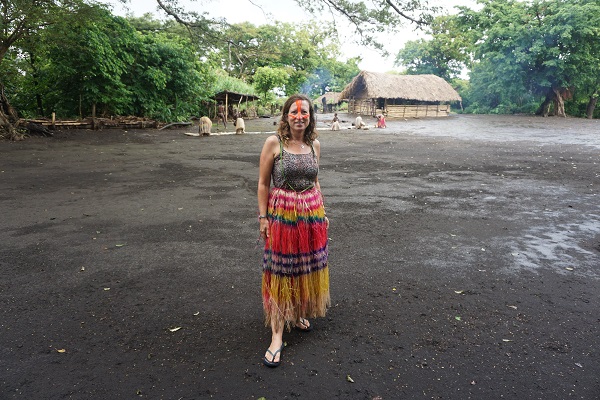
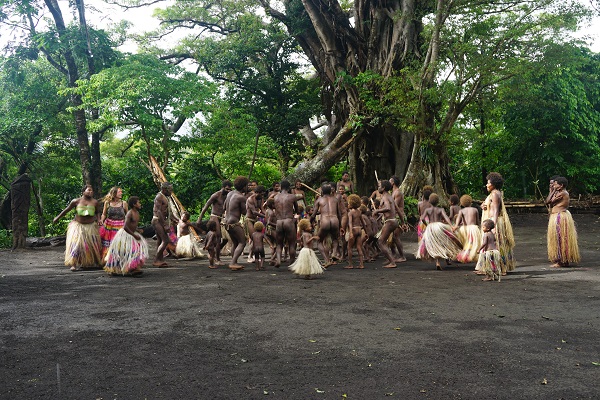
Now it was time to go out and join the rest of the village as they gathered under the banyan tree to take part in the dances. I wasn’t sure what to do, although having seen the ‘Tanna’ movie, I knew that there would be a lot of jumping! One of the younger women took me under her wing. We joined hands and I followed her lead. Altogether we did four different dances. In each dance, the men stand in the middle of a circle with the women around the edge. The men cup their hands together to make a loud clap and stamp their feet as they sing in unison. Individual women join in from time to time in a high, wailing tone. The dances involve jumping in time to the rhythm in a relaxed, joyful way. Sometimes, we skipped around the circle, first one way and then the other, or moving in and out in a Hokey Cokey kind of way. Before coming to the Kustom village, I thought the dances were laid on for the tourists, but according to our guide, they do them every evening, whether or not they have any ‘guests’ in the village.
After the dances, every man and boy came up and shook us by the hand and said ‘thank you’ in their language. Then the villagers laid out some handmade tools and pieces of jewellery which they sell to raise a little extra money. The prices were very reasonable and the items were some of the nicest we’ve seen for sale in Vanuatu. Finally, we were introduced to the chief. I recognised his face from the ‘Tanna’ movie where he played a fictional version of himself – ‘the chief’. In the film, he revealed that he’d met Prince Phillip and showed a picture of him shaking his hand. I asked him if it was true and he said ‘yes’. ‘Where did you meet him, Buckingham Palace?’ David asked. The Chief shook his head ‘Windsor Castle’!
After meeting the chief, it was time to offer our thanks and a payment of 2,000 Vatu each (about twelve pounds). The money is desperately needed. It allows them to have a mobile phone so that they can summon help if there is a medical emergency which requires a hospital visit and to send their children to school. Not many children in the village go to school, but this is beginning to change. However, unfortunately schools are not free on Vanuatu.
All too soon it was time to leave the Kustom village. The villagers had been so kind and welcoming, I was reluctant to take off my grass skirt and return to the modern world.
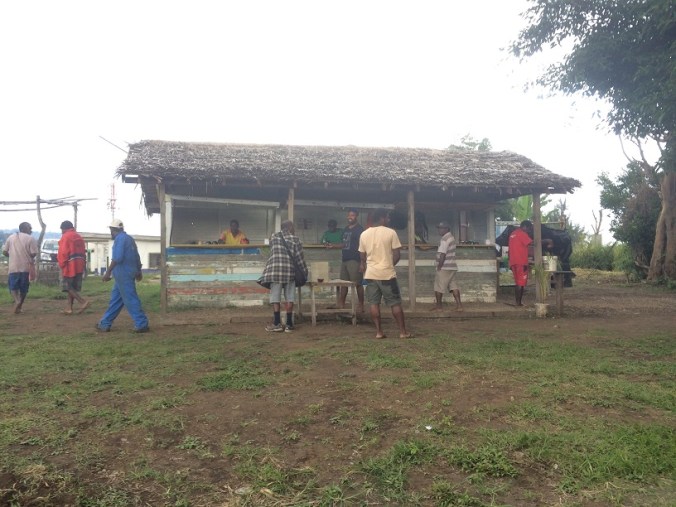
Back in our home stay, David and I decided to round off our ‘traditional’ day by walking to the local Kava bar and sampling Kava, a drink which is made by grating up the root of the Kava plant and straining it into water. It is said to offer a calming affect and to give a sense of well being. I only had one ‘shell’ but David had three, which puts him neck and neck with Prince Charles, who had three on his recent visit to Vanuatu. Neither of us noticed much effect beyond a numbing of the lips and tongue but I gather the affect is cumulative. On the walk home, I thought of the villagers of Ipai – the men gather together to drink Kava every evening and share stories and discuss any issues which have arisen during the day. I hope that they manage to steer their way through the challenges of the decades to come.
 Senior gap year