Sarlat-la-Caneda and the Lanternes des Morts, France

sarlat 1 small

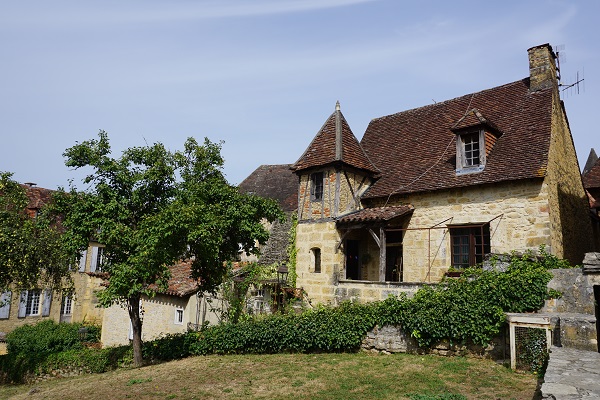
Sarlac-le-Caneda is a stunning town. Our campsite was on the outskirts, a ten minute walk to the perfectly preserved 14th century centre. It was a joy to wander round the maze of streets and winding passageways without being squashed – the streets are largely car free. In July and August, I imagine the number of tourists would be a challenge. Looking up at the turrets, the winding staircases, the arched windows and the balconies, I felt as if I was in a film set, so I was not surprised to read that it has featured in many films.  Apparently it was ‘saved’ by the dynamic Andre Malraux  (Minister of Culture, 1960-69) which earned him the honour of having a square named after him.  It developed around a large Benedictine Abbey, which later became the Cathedral.

sarlat 3 small

Above the Cathedral is a ‘Lanternes des Morts’, one of the many ‘lanterns of the dead’ which are dotted across the centre and west of France. These Moorish looking small, stone conical buildings with rooflights would be lit up at night to mark the position of a cemetery.

sarlat 2 small

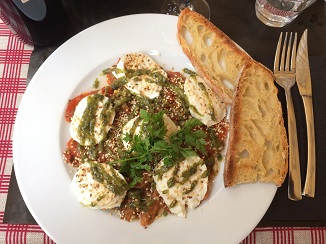
Around the central Place de la Liberte are a number of tempting restaurants, and we decided to sample one. It was a pleasure to sit outside and enjoy the beautiful location but the food wasn’t much cop – overpriced tourist fodder.

bad plate small

The whole town is obsessed with Foie Gras – there’s a large square dedicated to a goose market – but as a non meat eater, I was not even slightly tempted to give it a try.

nell sarlat small

Route de Noix to Sarlat-la-Caneda, France


The weather remained cool so we decided to cut our losses and head down to our next stopover a day early. Destination: the medieval town of Sarlat-la-Caneda.

At lunchtime, we came off the Satnav and wandered at will through the narrow lanes of the Hautes Viennes, into the land that time forgot. Abandoned houses standing empty, with birds flying in and out the windows. We came across the  tiny settlement of Pageas Chenevieres: just a farm and a few outbuildings, the thirteenth century church of Saint-Jean-Baptiste de Chenevieres and its large graveyard. Clearly this was once a thriving village. Some teenagers idly drove their car out of the farmyard and down through the fields as we set up our ‘picnique’ of bread and cheese.

After lunch, we came down from the Viennes and into the Dordogne. The drive through the Perigord region was beautiful with ancient hamlets, the houses made from a warm yellow stone, reminiscent of the Cotswolds. First we were surrounded by orchards of apples and then apple trees gave way to walnut trees – signs informed us we were on the ‘Route de Noix’.  All rather lovely.  Note to self: buy walnuts.

However, later that afternoon, David forgot the ‘look to the left’ rule and almost wiped us out at a junction. A scary moment. So now the ‘driving cock up’ score is one all –  and let’s hope we can leave it at that!


dave small

Ooops

Route de Tours, Dolmen de Bagneux and Samur


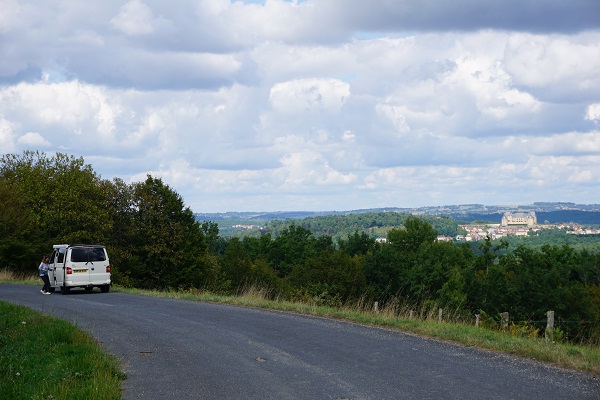
on the road small

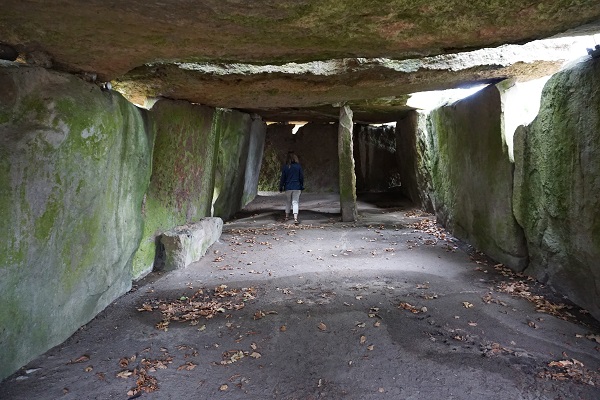
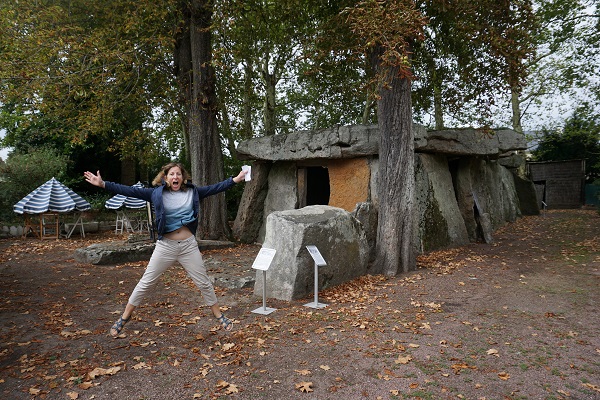
Today we were on the ‘Route de Tours’ the scenic route to Tours along the River Loire. As a coda to our trip to the megalithic menhirs at Carnac, we stopped off in the elegant town of Saumur, (birthplace of Coco Chanel, famous for it’s sparkling wine and its cavalry training academy) to see the largest Dolmen in Europe, the Dolmen de Bagneux. It’s a vast chamber, 23 metres long and three metres high, which is believed to have been used as a burial tomb. It is thought to have been built around the time of the first pyramids in Egypt, about 5,000 years ago. It’s a internationally important site, and so I was slightly taken aback to find it tucked away in the back garden of No. 56 Rue de Dolmen, just behind a café. An entry fee of 4 euros is charged by the café owner. The Dolmen itself rubs shoulders with the everyday accoutrements of a French back yard – a few plastic chairs, a table, a rusty slide. Faded information signs are strewn about or propped casually up against the Dolmen.  I couldn’t decide whether to be shocked or delighted by this. On the one hand, there is something slightly magical in the idea of opening a gate into a back garden and finding an extraordinary object like that – and perhaps if it was owned by the French equivalent to English Heritage or the National Trust, you wouldn’t be allowed to go inside or touch it.

dolmen interior small

At the same time, I am slightly appalled that such a treasure has been left in the hands of a private owner.  Some old newspaper cuttings in the café revealed that the Dolmen was for sale from 2005-2009 – Pascal Normand, the owner of the café wanted to move house but couldn’t find anyone to take it off his hands.  The article said that he was hopeful that an Englishman would buy it – ‘the English seem to love this sort of thing, the French have no interest’. I’m not sure if he got his wish or whether he is still stuck with it.

Wonder if he’s open to offers…?

dolmen jump small

Chateau de Brissac, Loire Valley, France

DSC00102

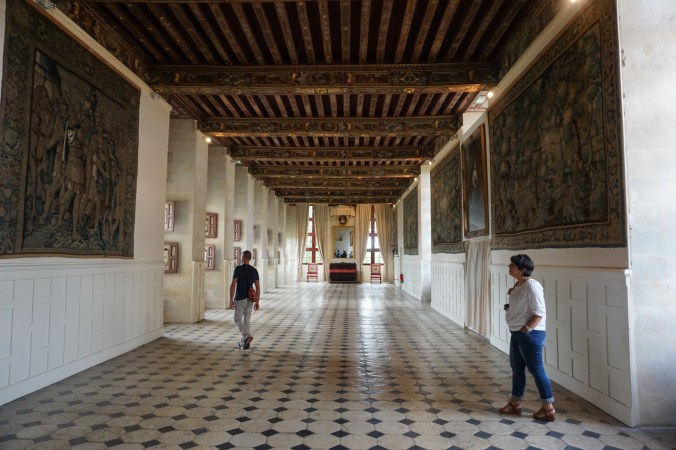
The long gallery

I woke to see the sun peeping out from behind the clouds and felt sure it was going to go be a better day. David volunteered to walk into Brissac-Quince, as it was market day today, and he was eager to feast his eyes on all the joys of a French market.  I stayed behind as I’m currently working on a script and surreal as it seems out here, I have deadlines to meet! He came back bearing a selection of fine cheeses, a beautiful Bass for the barbecue, and two cheeky slices of custard tart with prunes (Sorry, the French word escapes me) .

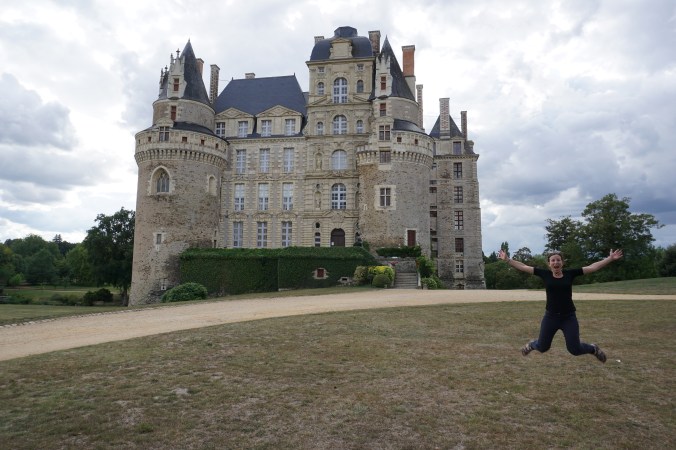
It was well into the afternoon before I’d finished work, and we decided to stroll into town again and perhaps sample a refreshing ‘Pression’ at a nice looking bar David had spotted on the main square (new word: draft beer).  As we approached the town we spotted the thrusting towers of a Chateau known as ‘Chateau de Brissac’.  It was hard to miss, since it is (as we later learned) the tallest Chateau in France. It was built by the Comtes de Anjou in the 11th century, but like many Chateaus it was ransacked during the French Revolution. Restorations began in 1844. Since we were in the Loire, and the Loire is supposed to be all about the Chateaux, we thought we ought to drop in and visit. We had to join a group as apparently the Chateau is still inhabited by the Brissac family (now know as the Cosse-Brissacs) and they’re not keen to have people wandering about their home looking at their unmade beds.  So a guided tour it had to be, at ten euros each. As we set off, I feared we may have made a mistake. I’m not a fan of a guided tour at the best of times and this one was in French. My A level French is a wee bit rusty.

I cast my eye round the first room – a drawing room, with the usual quota of fancy sideboards, ancient tapestries and fine china.  More surprising were the portraits of the present day residents rubbing shoulders with portraits of celebrities such as Sophia Loren, Roger Moore, Gerard Depardieu and Nureyev which were clearly taken at the Chateau. A hint of unexpected things to come.

Upstairs, we entered a vast empty gallery designed for large parties. I’m sure all those celebrities had some great times up there. The gallery led to a secret door – and who doesn’t love a secret door? –  which gave way to an intimate bedchamber where in 1620 King Louise IV and his estranged mother Marie de Medici met and were briefly reconciled before their two factions fell out once again. Again, unexpected.

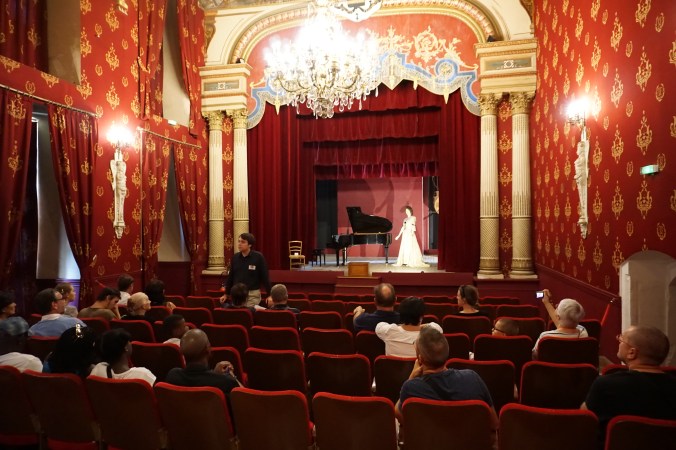
Up another flight of stairs, there was an entire theatre – footlights, curtains, lighting box, the lot. Built on the instructions of the widowed Marchioness de Brissac, Jeanne Say. Apparently, she was a brilliant soprano herself and inevitably received top billing at her festival, which was attended by the best musicians and singers of the day. She hosted her very own opera festival every Autumn from 1890 to 1916. On her death, it was closed for 47 years and was only then restored to its original state. It is still used for performances today.

DSC00109

Stuffed and mounted

Next, we heard about another talented Marchioness. Widowed at 27, she devoted her life to making the finest quality champagne.  She is better known as Veuve Cliquot – “the Grand Dame of Champagne”. I assumed  ‘Veuve Cliquot’ was just a brand name. Her portrait hangs in the Chateau. She is shown on the terrace of the Chateau with her great granddaughter, Anna. She is in her eighties: all dressed in black,  she looks a formidable old bird.  Anna – later known as Anna de Rochechonart de Mortenant – went on to become a well known writer, campaigner and feminist. She was the first woman in France to gain her driving licence. She was also the first to receive a speeding fine!

DSC00121

The underground canal

The tour ended with an invitation to try three Rose wines which are grown by the Chateau. We tried them all and purchased the (cheapest) five euro bottle. Why pay more…? It went down very well with the Bass David bought in the market.


DSC00129

Chateau de Brissac won in tombola by English tourist

Brissac-Quince, Loire Valley, France

DSC00045


Woke up to a cold day with heavy cloud and rain. After a late start, we hit the road, destination Domaine de L’Etang, a campsite just outside Brissac-Quince, Near Angers in the Loire Valley, a distance of about 160 miles. I was driving today, and maybe that was a bad omen because it turned into an epic fail day. If it was a movie, it would be arthouse and nobody would really enjoy it.

Act 1, we failed to recognise we were almost out of fuel until the dashboard light came on, which was just after we’d passed a petrol station. As we drove on, the fuel guage was edging towards zero and the nearest petrol station showing on the Satnav was 15 kilometres away. So we decided to come off the road and hit a town. Cue tense drive around a deserted town with no garage in sight. Just as we were resigning ourselves to breakdown, a petrol station icon started to flash on the Satnav – distance 2 miles. Would it be open? Would we make it? The answer was yes! We heaved a sigh of relief and filled our thirsty tank full to the brim.

Act Two, we took a tour of a neighbouring supermarket to stock up on items we had failed to bring. Corkscrew, knife, bread knife and lighter to name a few.

Act Three, on the way back to the payage, I failed to remember that on a roundabout, traffic approaches from the left side. David tried to slam on the brake but unfortunately he was in the passenger seat of the van so it did no good. No impact occurred but nerves were slightly further frayed.

Act Four, we struggled to find the campsite, taking a detour into a gypsy encampment. When we arrived, the rain was unrelenting. After setting up camp, we headed straight to the bar, expecting to find a bit of warmth and bonhomie. Alas, it was a cold and windswept tent with no one in it. We took our drinks in ‘the games room’, which would have been okay if we’d had any change for the pool table.

Act 5. We were tucked up in bed by nine o clock, resolving to do better tomorrow!


The Menhirs of Carnac, Brittany

Tuesday, 29 August 2017DSC00095
So today was the big day. The van was already loaded, so all we had to do was climb out of bed and stagger out into the sunlight to catch the ferry to Cherbourg.

I had a touch of ferry fear, as the last crossing I did was rough and I felt nauseous the whole way, so I’d popped a couple of travel sickness pills – but my fears were unfounded! The sea was calm and still. Out on deck, people were lounging around in deckchairs topping up their tans.  It seemed rude not to join them.

Back on the road, only suddenly everyone was driving on the right! David volunteered to drive the first stint. Maybe it was the travel sickness tablets, maybe it was the hot sun, but I fell into a sort of coma. As a result, I have nothing to report about the journey. I did notice a few vestiges of the Second World War, a blown up fortress as we came into the Port, an old airfield littered with bits of planes and military junk, but that was about it.

The chosen destination for day 1 was Carnac. David was keen to see The Stones – no, not the band, the prehistoric stones. The French equivalent of Stonehenge. He has pleasant memories of seeing them as a kid but the family was just passing through to get somewhere else and so it was a case of  “now you see em,  now you don’t.” He’s been wanting to go back ever since.  It was a long drive and we kept on diverting so we were tempted to stop somewhere closer and head over the next day. But in the end we pressed on and happened across a modest little campsite called Kerabus. I’m so glad we did.

DSC00081

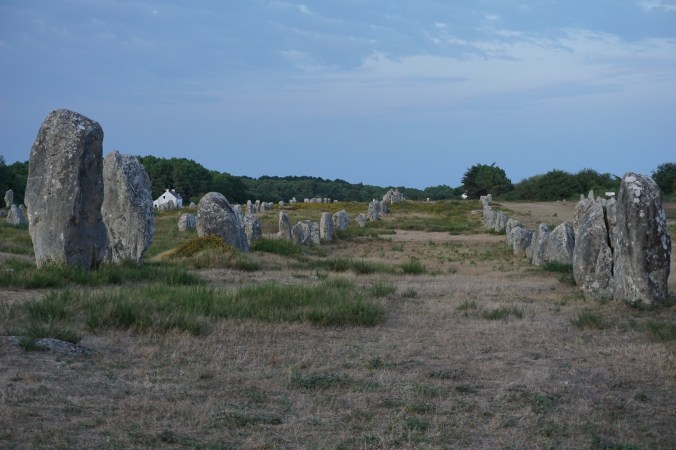
After setting up camp, we looked at the campsite map, and realised we were only a few hundred meters from the stones. So after knocking back a gin and tonic and devouring some prawns and baguette (real French bread is soooo good!)  , we set off to track them down. We found ourselves on a footpath through a pine woods and then it opened out into a field and bingo! We were walking alongside the Menhirs. I won’t say amongst them as sadly there was a low fence.

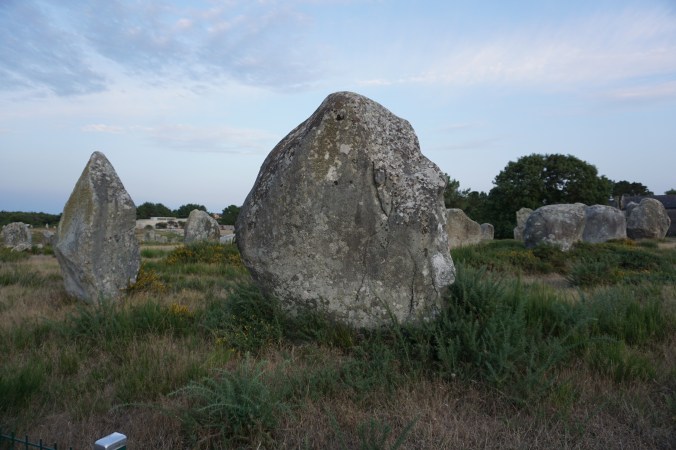
There were hundreds of them. (I read later that there are close to 3,000). The first ones we saw were only about a meter high, sticking out of the ground and surrounded by heather and gorse and grasses. We crossed a road, and there was another huge field full. In places they seemed to be in rows. In others, it looked more like circles. As we went on, we noticed the stones were getting bigger and bigger. And so were our gin-fuelled speculations.

What did it all mean?  We hadn’t read any guidebooks, all we knew was that they were built in Megalithic times, perhaps as long ago as 4.000 years.  Some of them were tall and pointy, like hands reaching for the sky, some looked like human faces, others like birds or animals.

Perhaps they were commemorative stones for kindred killed in battle, a bit like gravestones? Perhaps they were a map of the stars? Perhaps they represented a kind of spiritual journey from the little stones at one end to the massive great big ones at the other?  Or perhaps they were just art? Some of them would have given Henry Moore a run for his money.
DSC00092

Anyway, we loved seeing them. I was so pleased that we went out straight away as it was a beautiful evening. and the next morning we woke to find it cold, wet and windy.  My mother always told me to “do it now”.  I think you were right, mum!

What will we leave behind us on this earth for people to marvel at in 4.000 years? Or even 400?

I think I’d better leave it there!
DSC00101

Swanage Dorset, VW T5 adventure

Once upon a time there were a couple of middle aged marrieds called Nell and Dave who decided to turn their back on the mortgage, the nine to five and the gentle decline into old age and to go on an excellent adventure!  “What about the rest of the kids, the parents, the dog?” I hear you say, but the kids are all over 18 and thankfully the parents seem to be doing okay, and we’re not short of offers to look after the dog, so we’re going to be selfish and do this thing. You only live once, Carpe Diem, live adventurously and so on.

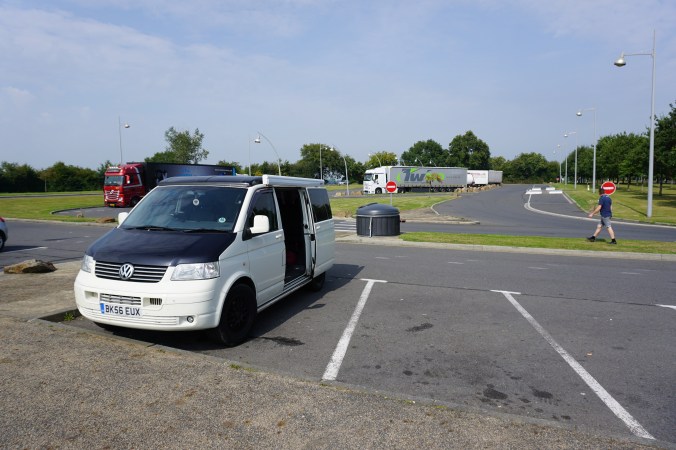
So, in just over a week we set off on the first leg of our Senior Gap Year.  That’s what the Americans call it, a  “Senior Gap Year”. And in the absence of another, more British phrase, that’s what we’re calling it. At about five in the morning on 29 August we’ll climb into our (VW T5 short wheel base) campervan and head for the 8:30 ferry from Poole to Cherbourg. After that, we’ll be bumbling about France and Italy for about six weeks.

So this week, our mission has been to get the van ready.  We already have a kitchen conversion with two hobs and a fridge. In addition we decided to:

  1. Replace the weedy tyres with sexy, chunky new ones.
  2. Add a pop top so that we can stand up in the van – and get some ventilation going on those blistering hot days.
  3. Add an awning to give us shade on those blistering hot days (notice a theme here? The weather in the UK has been rubbish this August and we’re both craving sun)
  4. Purchase dayglo jackets, a warning triangle and spare light bulbs to keep on the right side of the Gendarmes.
  5. Take everything out the van, clean the van, then put everything back in better.  And last but not least….
  6. Install a kick-ass stereo with mahoosive subwoofers under the front seat.

And then on the seventh day, we stood back and saw that it was good. Or was it…? What was that strange whining noise? It wasn’t there before. Quick search of the van. Unable to find the source. Maybe we’ll just leave it. But just imagine how annoying that whining would become as we drive through France, even if we could drown it out with the kiss-ass stereo. And how even more annoying when you’re trying to sleep. So today we –

7. Bought a replacement Zig-zag unit. What is a Zig-zag unit? I have no idea, but thankfully, Dave does. And hopefully, he knows how to replace it. And hopefully, replacing it will stop the annoying whine.

Hopefully.