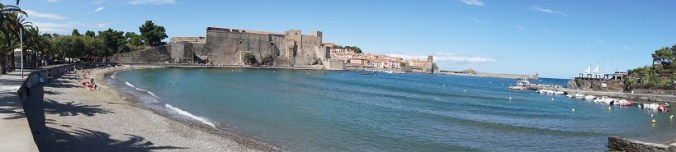
From Les Amandiers, it is a two minute walk down to the beach at L’Ouille and then a further twenty minutes walk over the cliffs to Collioures. The walk is wild and spectacular, clinging to the edge of the cliffs or winding inland past Fort Carre, an ancient defence against the Spanish. This part of the country has been fought over by the French and Spanish for hundreds of years. Collioures itself was originally a Catalan fishing town (“Coltiures” in Catalan) specialising in anchovies and sardines, and it is still possible to buy anchovies in the town. The fishing trade has long gone. The town has become a magnate for tourists, drawn by the beautiful curving bay lined with restaurants, the steep, winding streets full of gift shops. The houses are painted in various shades of ochre and terracotta, all set against a backdrop of the Pyrenees.
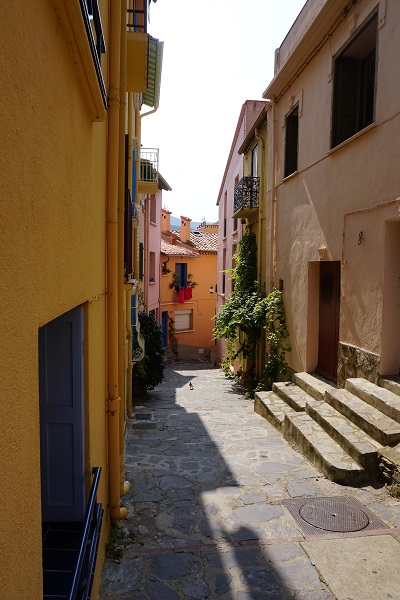
The town has a strong artistic bent which dates back to the turn of the century and its association with artists like Matisse, Derain, Bracque and Picasso. I’ve been reading the first volume of ‘The Unknown Matisse’ the brilliant biography of Matisse by Hilary Spurling which I’ve borrowed from my parents (thanks mum and dad!) and Collioure features heavily. Matisse was the first artist to ‘discover’ Collioure and paved the way for many more artists to come here.
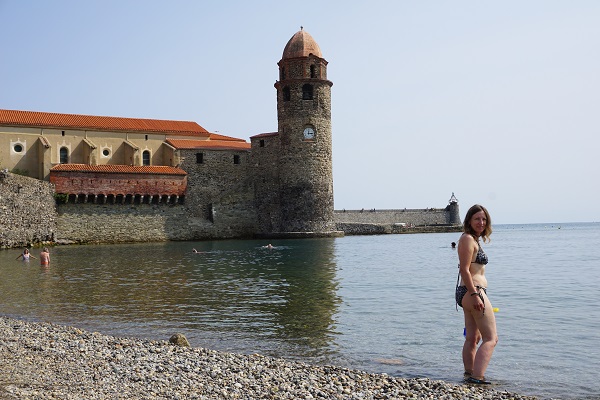
In 1905, Matisse was looking for somewhere cheap to paint for the summer, and having travelled by train from Paris to Perpignan, he continued West down the coast until he reached Collioure. Board and lodgings at the station hotel was secured for the bargain price of 150 francs a month for Matisse his wife Amelie and their children. That summer turned out to be momentous for Matisse, who was soon joined by another young artist, Derain. They set up a studio above a café overlooking the bay. Together they painted round the clock, producing dozens of canvases. They painted scenes of everyday life in the village: boats departing to fish in the morning, boats returning at night. They painted the fisherman, their wives and daughters, the sea and the distinctive tower of the church of Notre-Dame-des-Anges, a converted lighthouse which dominated the view from the studio.

Today, swimming at Collioure is a joy, with several different beaches to choose from. The fish are so tame you can get them to take bread from your hand. But in 1905 the water was a thick stew of fish guts and sewage, so each day Matisse and family walked round the cliff top path to swim in the clear waters of L’Ouille. The same path cliff top path that we walked from L’Ouille to Collioures! There are several well known paintings of Amelie, his wife, posing on the rocks at L’Ouille.
The light at Collioure, which today inspires tourists to take endless photos of the town, inspired Matisse and Derain to tear up the rule book and allowed themselves to focus on light and colour. As Derain wrote in a letter to a friend,
“colours became sticks of dynamite. They exploded into light.”
The resulting works created a furore when they were exhibited in Paris. The term ‘Fauves’ was coined to describe this shocking new art work by critic Louis Vauxelles – ‘wild beasts’. And yet, very soon, the work began to be recognised as extraordinary. Leo and Gertrude Stein purchased ‘Woman in a Hat’, an image of Amelie, and soon other collectors caught on. Painters such as Picasso and Braques were inspired to imitate or outdo. Matisse’s place in the history of art was assured.
Today, there are a number of Matisse and Derain’s works displayed round the town, positioned exactly where they were painted. There are also several empty picture frames which you can look through and see an image of the town ‘framed’ as a work of art. And of course, there are artists studios everywhere, as artists continue to be inspired by Matisse – and by Collioure.
 Senior gap year
Lovely Nell! I’m glad you like the book. Coincidentally I m going to see Matisse’s studio at the Royal Academy with Sue at the end of the month.
LikeLike
Oh, interesting, let me know what it’s like. I found it a bit odd that Matisse’s studio in Colioure was not marked in any way.
LikeLike