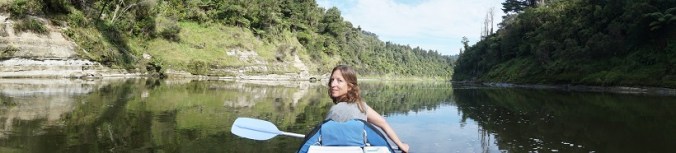
The journey down the Whanganui River is designated one of New Zealand’s 10 Great Walks – despite the fact that it is not actually a walk, but a paddle! Inspired by our experience on the Abel Tasman Trail in South Island, we booked ourselves onto a three day ‘freedom’ canoe adventure with Yeti Tours – we would be travelling about 55 miles down the river – without a guide. Quite a challenge for a couple who have only canoed twice before.
The adventure began at 7 am on the first day when we were picked up by our Yeti tour leader. The day before, he had given us a number of watertight barrels to hold all our stuff . So into the barrels went sleeping bags, waterproofs, pots, pans, gas stove, dry food etc etc. He also gave us a cold box (or Eski as they call it over here) for fresh food. Finally, he gave us a satellite emergency communication device with a button to press at the end of each day. This would send him our position so that he’d know that we’d arrived safely. There was a second button for ‘we are in slight trouble’ – if we pressed that, he’ d get in touch with a jet boat driver and they’d send someone along to see if they could help us. And lastly there was a third button, the nuclear option. Press this and we would summon the emergency services, who would immediately send a helicopter to airlift us out.
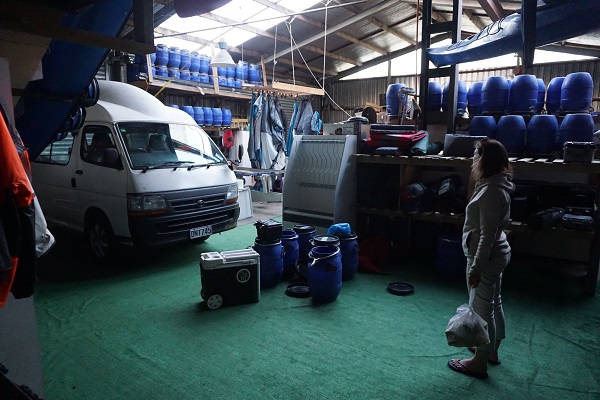
He then drove us for a couple of hours to Whakahoro (population 8) which was the start of the trail. The second hour of the drive took us into deep, deep countryside, even by New Zealand standards. In that hour, we only passed two cyclists and a walker. This was true isolation! At the edge of the river, he gave us a few minutes of instruction – the best way to paddle, how to recognise and avoid obstructions, what to do if we fell out – and warned us that towards the end of the final day we would face some challenges. There was one particularly nasty rock which had wrecked a number of canoes which we had to look out for. And there were several challenging rapids. The final and most challenging rapid was known as the Fifty/fifty, because you had a 50% chance of capsizing. Would we be one of the unlucky ones and end up in the drink….!??
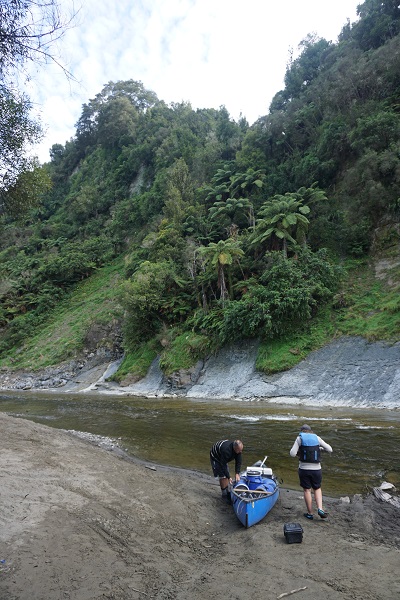
It was somewhat surreal, waving our guide goodbye and setting off down the river on our own. However, it was a beautiful day and we soon hit our stride and got into a rhythm. We were sharing a Canadian style open canoe. I was at the front, paddling constantly, my paddle to the left – I was ‘the engine’. David was at the back, paddle to the right, correcting our course – he was ‘the driver’. I soon realised that whilst I was paddling all the time, David needed to do much less – until we hit a rapid and then it was over to him to steer our course. The rapids came along about every 10-20 minutes. At first, I found them nerve racking – especially having to dodge stones and trees submerged under the water – but we soon got the hang of looking ahead and learning how to spot obstacles.
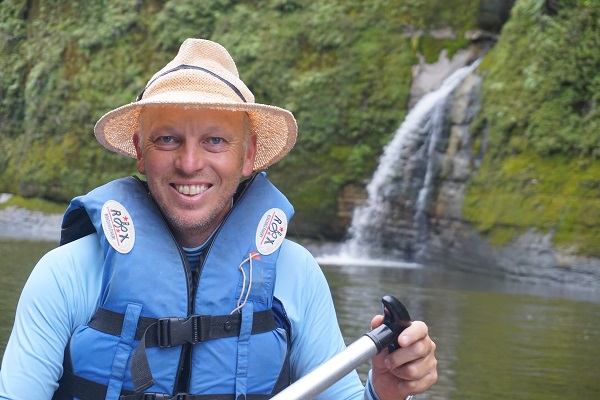
The scenery was stunning – the banks of the river gorge towered above us, covered in thick native forest, including vast tree ferns. As the sun rose higher, the deep green foliage reflected in the water so that we were completely surrounded by green.
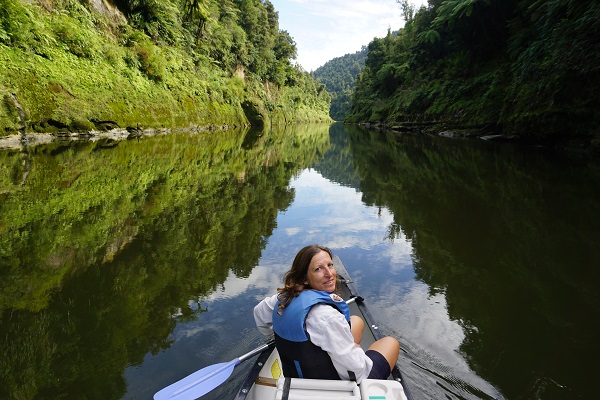
Every two hours a sign would appear for a campsite. Then we would pull in, tie up our canoe and walk up to a campsite – a modest affair with a few picnic tables, a composting toilet and a sink with a rainwater supply.
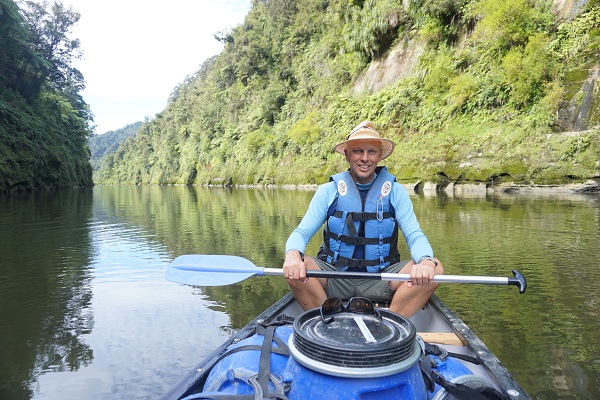
As the journey progressed, the silence thickened. It was broken only by the sound of bird calls. The park is particularly rich in birdlife, with river birds such as the whio (blue duck) and cormorants and small birds such as robins, warblers and fantails. Swallows dipped in and out of the water, catching insects or taking a drink. This was true wilderness, with no sign of human habitation. Yet, somehow my brain refused to accept it. I kept seeing ancient signs of human habitation – bridges, foundations of buildings – where there weren’t any. Every piece of driftwood or stone looked to me like an upturned canoe or a person.

The river is sacred to the Maori and before the Europeans arrived, it was heavily populated, but there is no trace of this now. The steep bluffs and ridges were used as sites for ‘pa’ (fortified villages) which were needed to protect them from intertribal warfare. There’s a film about it, which was shot on location, called the ‘River Queen’ which I really want to see.
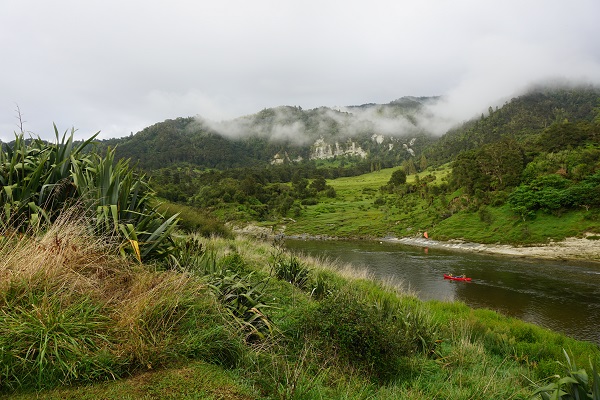
Later, the Europeans arrived and by the turn of the century the river had become a popular thoroughfare for tourists on pleasure cruises. It was known as the ‘Rhine of Maoriland’. After the first world war, land was distributed to returning soldiers looking to start lives as farmers. Maoris were excluded from this, even though they had fought in the first world war. The settlers failed to thrive and eventually, the settler farms were abandoned. When the railroads opened up, the river trips gradually died out.
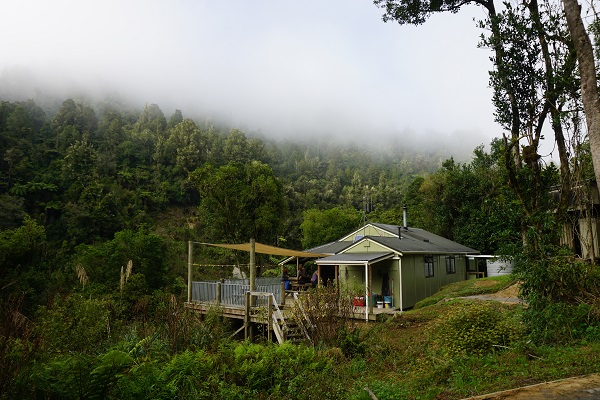
Whether the ‘sacredness’ of the river had rubbed off on me, or whether it was just the peacefulness and tranquillity of the experience, I’m not sure but by the end of the first day I felt very calm. I also felt very tired! Fortunately, David had something up his sleeve to liven me up – champagne! I’d almost forgotten – it was 4th March – my birthday! We were staying in the John Coull hut, which was similar to the other huts we stayed in when we did the Abel Tasman Trail. It was beautifully kept by a pair of volunteers, retired brothers who stay at the hut for a week a few times a year. David had got me a card and a few presents. There were a dozen other canoists at the sight, and maybe because of the champagne or maybe because we were all in this experience together, we were soon chatting and laughing together. After dinner, David pulled out a raspberry tart which had been gently defrosting in the bottom of the Eski and was now ready to eat. We shared it with a couple of hungry ‘Gap Year’ travellers who’d been living on tinned spaghetti for weeks.
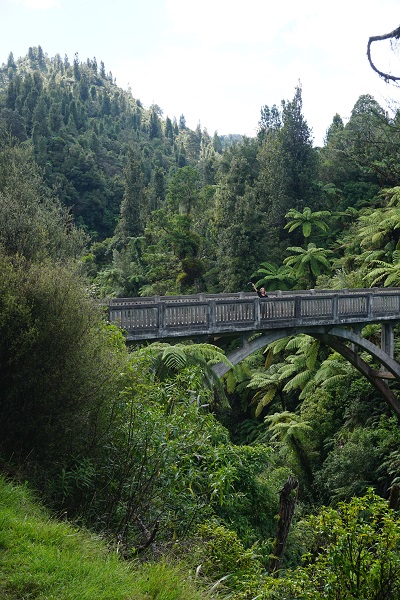
The next day, we set out on the river again. Once again, we did three legs of about two hours each. It was forecast to rain in the afternoon but the day stayed clear. At lunchtime, we walked about 40 minutes into the forest, crossing small streams and climbing up higher and higher until suddenly out of nowhere appeared ‘The Bridge to Nowhere’. The evidence of human habitation I was looking for! This concrete folly was built to improve trade to the farmers who came here in the Great War, but the settlers had left by the time the bridge was completed in 1936 and it now serves no function apart from as a curious tourist attraction. David looked down below and saw several eel swimming in the stream below us, a reminder of a time when Maoris fed on eels and thrived here.
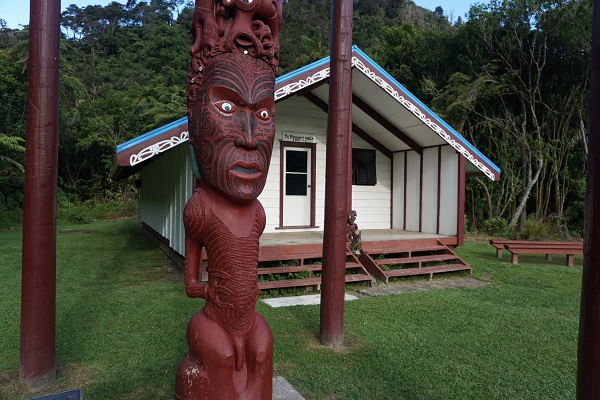
Arriving at the hut for our second night, we discovered it was also a Maori encampment. Unfortunately no Maoris were in residence – when they are there, they give visitors a traditional Maori welcome with songs and speeches – and visitors are expected to reciprocate! One American family had been practicing their song all day and were disappointed to find the Maoris were not there – although I’m not convinced their rendition of ‘Bohemian Rhapsody’ would have gone down as well as they hoped!
The third day dawned, with a lowering mist and a hint of rain. We ignored it and carried on in shorts and T-shirts – just as well, as the rain soon stopped and the weather grew warm. I felt tired and was struggling to find my ‘rhythm’ – when suddenly, the final challenges began. First, there was the massive rock which had totalled so many canoes. We managed to get around that without too much trouble. Next was a pretty good rapid which shot us out and span our canoe round. We were both a bit breathless but no harm done. But finally, after lunch came the good old fifty fifty – and that’s when it all went wrong!
David steered us confidently right into the roughest bit of water – we hit a standing wave and the front of the canoe dipped down, filling us with water. Then it came in the side. A moment, as we looked at each other and then, we were in the water. A shock of cold but no harm done. We held onto our paddles, clinging onto the canoe. We were heading full speed for a large rock. I made the decision to let go of the canoe, and found myself shooting out towards a rocky beach. I lay on my back and kept my feet up, as instructed, letting my life jacket do the work. I started to head towards the beach, wanting to climb out, but then realised I was stuck in an eddy and was getting nowhere fast. At this point, a jet boat with a load of tourists heading for a trip to the ‘Bridge to Nowhere’ came past. The driver slowed to check if I was alright. I signalled frantically – yes, I’m okay – thinking to myself ‘please go away! I really don’t want to be rescued!’ Fortunately, he moved off.
I looked around and saw David, still with the canoe, edging his way round the back of the rock, aiming to cross further downstream. Clearly, I needed to get back to him and so I stopped trying to swim to the beach and edged my way back into the current. I eventually managed to reach David, who had now reached the shore. We tried to tip the water out the canoe but it was too heavy. We put our addled brains together and recalled the instructions our guide gave us at the start of the tour – take everything out of the canoe and then empty the water. This worked. Meanwhile, I realised I was shivering and needed to change into a set of dry clothes or risk hypothermia. A couple of elderly canoists who had just come down the rapids with no problem stopped to ask if we were okay. Oh, the humiliation! We climbed back into our canoe and started off slowly again. The capsize had really taken it out of me, paddling was suddenly such hard work.
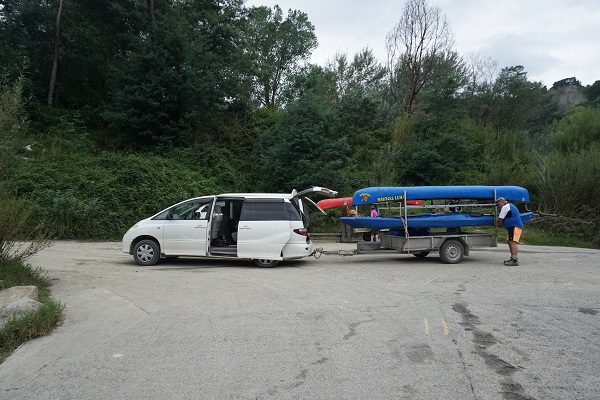
Twenty minutes later, we hit one final rapid, and this time, we managed to stay upright, limping over the finish line, the last boat but one to arrive. As soon as the canoes were loaded up and we were in the car, I fell asleep. The Whanganui journey had been a wonderful experience – but it was a relief to be back on dry land and in one piece!
 Senior gap year
Wow! What a memorable birthday. It sounds wonderful (most of the time). And you must be getting incredibly fit. XXX
LikeLiked by 1 person
You guys are amazing!!!!
LikeLike
Thanks, Lu! Had to take a couple of days off after that!! xx
LikeLike